Chenille body
A deep yarn pile stitched over the base — the surface that gives a varsity patch its weight and its softness.
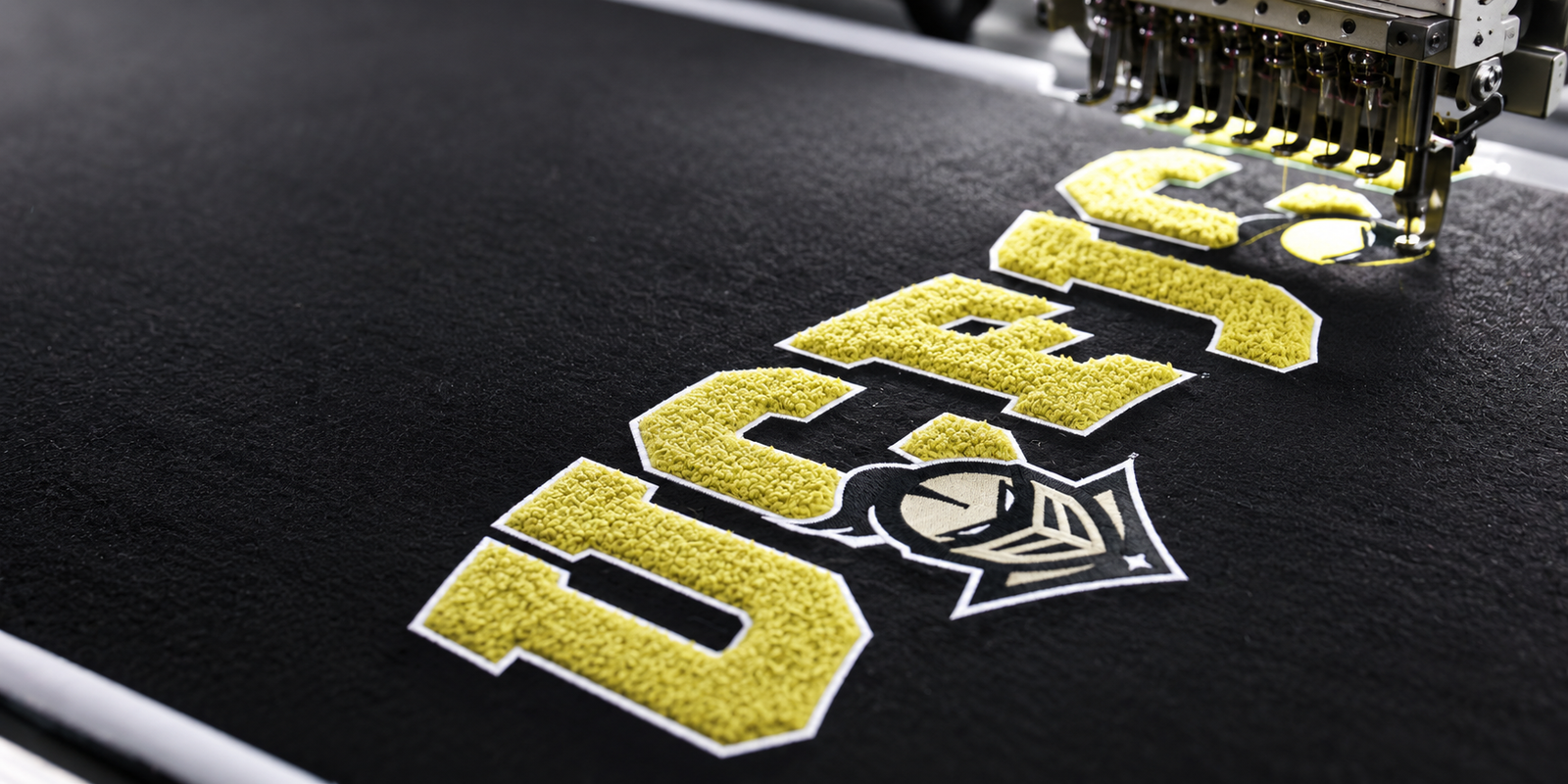
The making
Five stages, each with an owner and a record. The sample you approve is what every piece in the run is measured against.
Letter layout, letter height, line weight, yarn colours, base felt and the finished size are checked before anything is quoted.
Letters are set to the layout, the yarn and outline colours are fixed, and a proof goes back for sign-off.
A physical chenille sample for your approval — often inside 2–3 days when capacity allows.
The yarn body runs on our computerized embroidery platform, then the embroidered outline and detail are stitched over it.
Contours cut on 30+ vision-guided machines, backing applied, then inspected against the sample you approved.
Construction
A yarn body over a base, framed by flat embroidery. Each layer has a job, and the artwork decides which layer carries what detail.
A deep yarn pile stitched over the base — the surface that gives a varsity patch its weight and its softness.
A tighter looped pile with a finer, more even surface, used where the motif is smaller or sits beside flat stitching.
A flat-stitch border that frames the yarn body, holds the shape and carries the detail the pile cannot.
Chenille over embroidery over a felt base. The layers are what keep the edge clean once the pile is stitched.
Single letters, numbers and short wordmarks are the classic chenille format — and selected letters and numbers are kept in stock.
A thread-wrapped merrowed border, or a contour cut along the artwork outline on our vision-guided cutting machines.
Detail limits
The pile is what makes chenille read across a room, and it is also what fills the small gaps. The workable height is confirmed from your layout rather than from a size chart.
The same lettering at the same size: on the left the shape is built from yarn pile; on the right the fine detail stays flat, because the pile would swallow it.
Small text, hairlines and tight counters therefore move to the embroidered outline, or to another process entirely. Artwork review checks the letter height and the smallest mark at the finished size, and tells you which part should be stitched how — before sampling.
What artwork review checks
Working from a design that is not right for chenille? We will say so, and move the fine detail to embroidery, woven or print rather than build a body that muddies.
Applications
Varsity, collegiate and team programmes — the garments where a raised letter is the point.
The classic placement: letters and emblems on wool and felt.
Team letters and numbers in club colours.
Crewnecks and warm-up wear that carry a raised mark.
Letter programmes and alumni editions.
Repeat sets where colour and letter height come back identical.
Chenille used as a statement surface on limited runs.
Structure
Felt base, yarn body, embroidered outline, backing. The structure is confirmed on the spec sheet before sampling, because it decides how the piece attaches and how it wears.
The stable ground the yarn is built on, which keeps the shape and the letter edges crisp.
The chenille pile itself: the layer that gives the piece its depth and softness.
Flat stitching that frames the body, locks the edge and carries detail the pile cannot.
The adhesive, hook-and-loop or plain structure that decides how the piece attaches.
Plain back, no adhesive — the usual structure for varsity jackets, wool and leather.
Heat-activated adhesive film, applied with a heat press.
Hook side on the piece, with matching loop tape supplied.
Pressure-sensitive backing for temporary use on hard surfaces.
A thread-wrapped edge sealing the perimeter, for circles, shields, ovals and rectangles.
Cut on the outline by our 30+ vision-guided machines, for letters, irregular shapes and inside cut-outs.
Manufacturing
Chenille and towel-stitch bodies run on our computerized embroidery platform — 50+ machines in a 7,000 m² facility in Guangzhou — with cutting, backing, finishing, inspection and packing in the same plant.
Computerized multi-head machines that also carry chenille and towel-stitch work.
Camera-guided contour cutting for letters, mascots and irregular shapes.
Embroidery, cutting, finishing, inspection and packing in one building.
Set-up, machine operators, finishing and QC teams working from one specification.
Chenille and towel-stitch work running on the computerized embroidery floor.
Letter set-up, yarn colour and outline colour checked against the reference you approved.
Trimming, backing, inspection and packing before the shipment leaves the plant.
Keep exploring
The chenille range carries the specification; the process and procurement pages cover the other constructions, artwork, samples and dates.
Page last updated · Maintained by the LOVECOLOUR artwork and embroidery team in Guangzhou
FAQ
Short answers to what buyers ask before sending artwork. Anything project-specific is confirmed in writing at review.
A deep, soft yarn pile stitched over a base — felt in most varsity work — and framed with flat embroidery that holds the outline and carries the fine detail. The towel-stitch variant beside it is a tighter, more even loop. Both are stitched constructions rather than printed or moulded surfaces, which is what gives them their weight and depth.
Not in the yarn body: the pile fills the gap, which is why small text and hairlines belong to the embroidered outline or to another process. Artwork review checks the letter height and the smallest mark at the finished size and tells you which part should be stitched how, before anything is sampled.
Chenille is at its best on large letters, numbers and emblems that read across a room, and on large-area graphics where the surface itself is the point. The workable height depends on the letter shape, the yarn and the finished size, so we confirm it from your own layout instead of publishing one number that would not hold for every letter.
Sew-on is the usual structure on wool, felt and leather. The adhesive structures we run for our other patches — iron-on / heat-seal, hook-and-loop and self-adhesive — are confirmed for chenille on the spec sheet before sampling, so the attachment matches the garment it is going onto.
Each product has its own standard MOQ, and for many custom items it starts at around 100 pieces. Chenille letters, numbers and selected popular designs are also kept in stock for faster delivery, smaller trial orders and quick replenishment. For a fully custom run below the standard MOQ the unit price can increase.
Bulk production usually takes 7–12 days after artwork approval, and a sample can be ready in about 2–3 days when capacity allows. Rush orders are reviewed case by case against production capacity, material, artwork status and shipping method, so a rush date is confirmed rather than promised.
Direct factory collaboration
Include the letter height, the layout, the quantity and the garment the patch goes onto. We check what the yarn can carry, tell you which detail should be stitched flat, and come back with a factory-direct quote — or say plainly that another construction suits the design better.