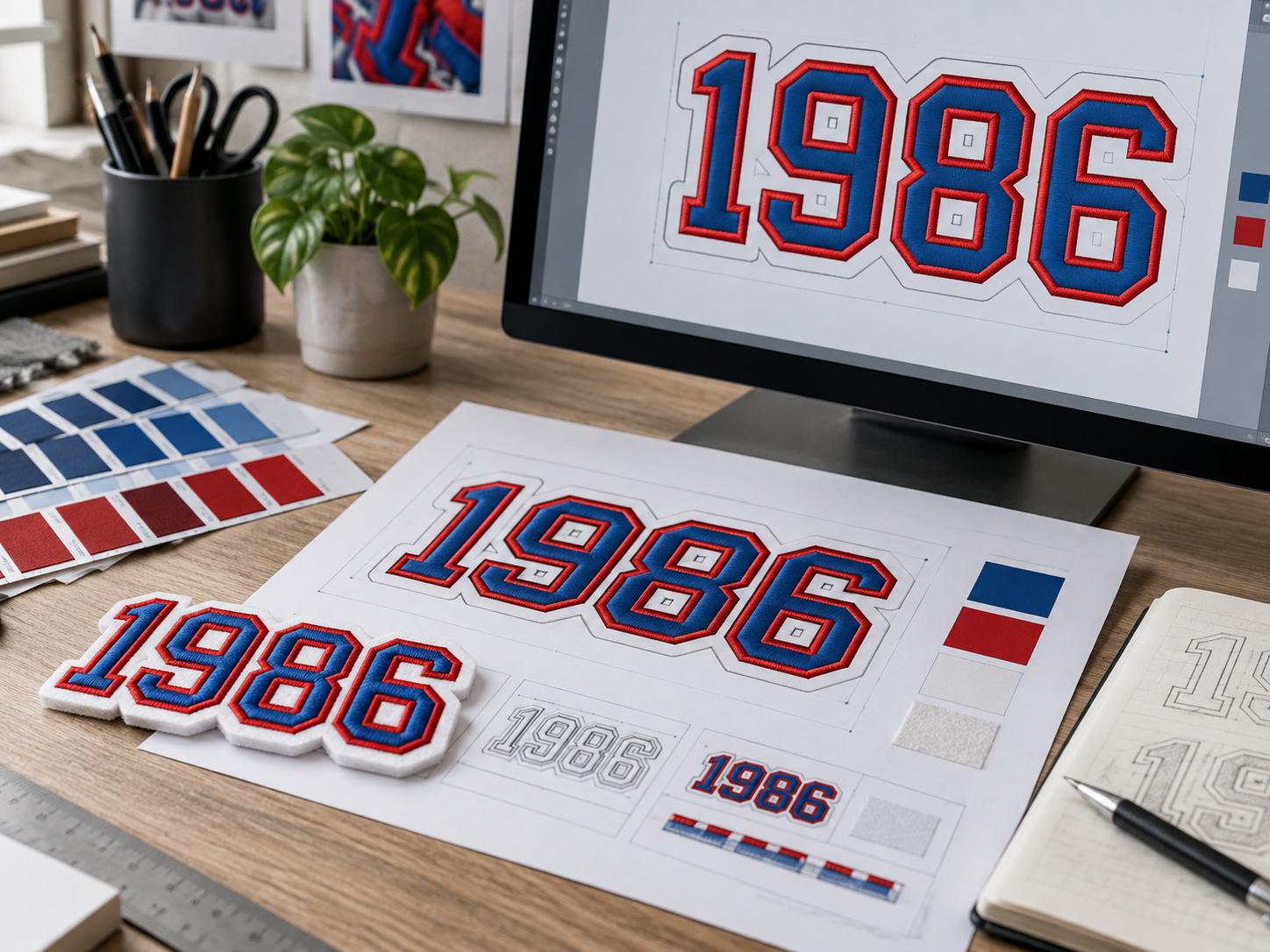
An artwork file open on screen beside the printed proof and the finished patch it was built from, on the review desk at LOVECOLOUR.

Procurement guide

Send the artwork. We will say what it can carry.

Every order starts with a file being read against the process that would make it — before a price, before a sample, and long before a machine is set up.

This page is what that review does: what it looks at, where artwork usually goes wrong, and how the answer comes back to you. It is the first stage of the flow on How We Work, and the reason a quote is never a guess.

  • Direct manufacturer
  • Baiyun District, Guangzhou
  • Artwork reviewed before quoting
  • Pre-production sample

The file

Send the highest-quality version of the artwork you have.

That means the original master file rather than a screenshot, a photograph of a screen, or a copy that has been forwarded through a chat app and compressed on the way. If a logo, an image or a sketch is all that exists so far, send that: it is how most projects arrive, and which process suits it is the factory's judgement to make, not something a buyer is expected to know in advance.

Nothing has to be complete before it is sent. Whatever is missing is asked back rather than guessed at, and the file is read before a price or a sample is committed to — a quick reply is never an inaccurate rough number.

What the review needs beside the file

  • Product type
  • Size you need it at
  • Quantity
  • Material and backing
  • Application or end use
  • Destination country
  • Packaging requirement
  • Required in-hand date, for a dated project

If the piece is going onto apparel, kidswear, outdoor or tactical gear, or into a brand's own standard, say so with the file. Material, environmental, testing and certification requirements are confirmed before an order rather than after it — and if something is required that we cannot evidence, you hear that at review rather than at the packing table.

AW01 · 1200×800 (3:2) Artwork open on screen at its finished size beside the printed digital proof and the patch produced from it.
AW01 · Artwork, proof & finished piece Own photography · 1200×800

The review

The artwork decides the process, not the other way round.

Line weight, the smallest text, the border and the finished size are what a process is chosen from. Every point below is checked at the size you actually need, not from a thumbnail.

Embroidered work

Stitched artwork, checked at its finished size

  • Logo proportion
  • Small-text clarity
  • Fine-line feasibility
  • Stitch direction
  • Stitch density
  • Thread colour
  • Border structure
  • Finished size
  • Backing
  • Cutting line

Checked before a program is built and before a price is given, because all ten decide whether the design survives being stitched.

PVC & rubber

Moulded artwork, checked layer by layer

  • Colour matching
  • Layer definition
  • Small-text feasibility
  • Line width
  • Surface effect
  • Edge quality
  • Product dimensions
  • Backing strength
  • Bulk consistency

A moulded piece carries relief and depth rather than thread, so what is checked is what the layers and the mould can actually hold.

The decision

Whether it holds, and in what.

The review answers one question first: does this design hold in the process you have in mind, at the size you need? Where it does not, the recommendation is to adjust the size, simplify the artwork or move to a woven, PVC or other more suitable process — instead of producing a specification that cannot be executed. Where more than one process would work, the difference between them is set out and the choice stays yours.

Small text and fine lines are where this usually bites. A thread has width, and a design that leans on legibility below what the process can carry is caught here rather than at the sample bench.

Colour

A reference, and how it gets confirmed.

Pantone is used as the production reference, and it is not a 100% physical guarantee from one material to another. Confirmation comes from a thread colour card, a PVC colour sample, a material sample or a physical sample. Where no Pantone is supplied, the closest colour is matched from the artwork and the difference a screen introduces is flagged — and a project with high colour requirements is advised to approve a physical sample rather than a screen.

The review also settles the parts of a piece that are easy to leave undecided: the border structure and the cutting line for a stitched patch, the layer build for moulded work, and the backing the finished piece is applied with. All of them are part of the same check, because a beautiful file with no attachment decision is still not a producible specification.

Common problems

Six things that move a sample off course.

Buyers do not send bad artwork; they send artwork that has never been tested against a process. These are the six that come up most, and each one is answered before a sample is made.

  1. 01

    Small text in a stitched process

    A thread has width, so a line of type that reads perfectly on screen can close up when it is stitched. The review measures the smallest element against the finished size and says what will hold.

  2. 02

    Detail that only exists at one size

    Artwork is judged at the size you need it, not at the size it happens to be drawn. The same logo can be perfectly workable on a large piece and lossy on a small one — which is why the size belongs in the brief, not in a later email.

  3. 03

    Colour that has to cross materials

    One reference does not survive a move from thread to moulded rubber to woven fabric identically. That is why confirmation is a colour card or a physical sample rather than a number on a file.

  4. 04

    Structure left undecided

    Border structure, the cutting line, the layer build and the backing decide how a piece attaches and how it wears. Left open, they are decided by whoever runs the machine — so they are settled during review.

  5. 05

    An old version of the file

    Producing a superseded artwork is the single most avoidable error in this trade. Every version is recorded, and only the final approved version can be produced — an earlier file cannot reach the line.

  6. 06

    Tone rather than shape

    If the design depends on smooth colour transitions, photographic tone or very fine shading, that decides the route as much as the outline does. Say it with the brief and the review answers it against the process, rather than leaving it to be discovered at the proof.

AW02 · 1200×900 (4:3) Artwork on the review desk with its smallest line of text enlarged, next to the thread card the colour was matched from.
AW02 · Smallest element under magnification Own photography · 1200×900

The answer

Four steps from file to approved artwork.

A review produces something you can check, not an opinion. Each step below ends in a document, a proof or a physical piece.

  1. Step 01

    Feasibility & process recommendation

    What the file can carry at your size, which process reproduces it, and — where something will not hold — what to change: the size, the artwork itself, or the route.

  2. Step 02

    Production artwork & digital proof

    The file is built for production and shown back to you as a digital proof. This is the base confirmation on which everything physical is made, and the point at which a wrong colour count or a stray detail is still cheap to fix.

  3. Step 03

    Your confirmation, and the version that counts

    You comment, the file is corrected, and the approved version is recorded. From this point the approved version is the only one that can be produced: an earlier file cannot be used, by anyone.

  4. Step 04

    A physical sample where the work calls for it

    A new design, complex artwork, dense small text, a high colour requirement, a special material or process, a large order, an important event or a high consistency requirement is made as a physical sample — and once approved it becomes the standard the bulk run is measured against.

What that leaves on the record: with a physical sample, the production standard is the final production artwork plus the approved physical sample; without one, it is the final approved production artwork. Neither is a verbal approval, and both are attached to the order number. Samples & Approval covers the sample stage itself, and How We Work places it in the ten-stage flow.

Direct factory collaboration

Send the file, and the brief around it.

Include the product type, the finished size, the quantity, the material and backing, the end use and the date you need the goods. The file is read and answered with the process that reproduces it — or with the change that would make it producible.