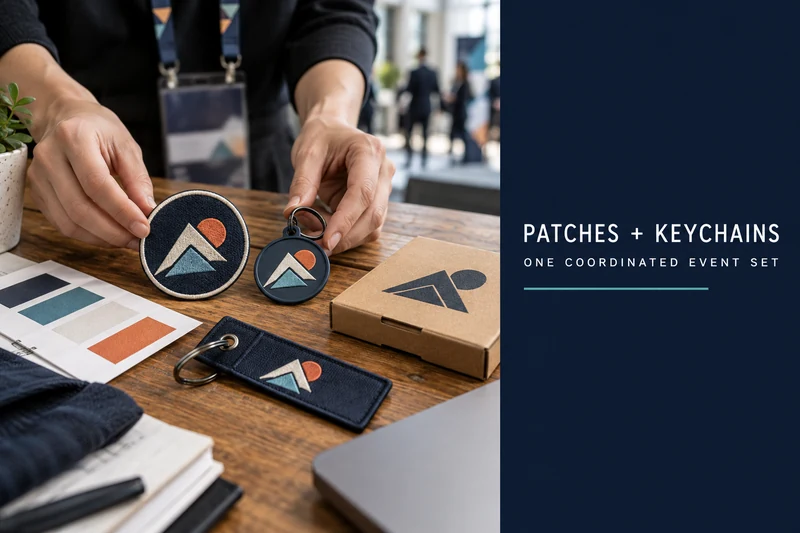
An event patch and a keychain can share the same logo and still look like they came from two different projects. Perhaps the colors are slightly off. Perhaps the patch carries the full event name, while the keychain uses an abbreviation nobody approved. Or perhaps both products look great, but the volunteer team cannot tell which version belongs in the VIP bags.
That is why we treat an event merchandise set as a small product program, not two unrelated promotional items. Before choosing materials or requesting prices, define who will receive each item, what it needs to do, and how it will be packed and distributed. The design decisions become much easier once those answers are clear.
Start With Three Different Goals: Identification, Keepsakes, and Retail Merchandise
The word “event merch” can describe products with very different jobs. A patch used to help visitors recognize a volunteer should be easy to identify quickly. A souvenir patch should remind someone of the event months later. A retail patch must look appealing enough for someone to choose it—and pay for it.
Staff and volunteer identification: Use a clear role name, strong contrast, and a placement that remains visible when the person is working. A removable patch on a prepared garment or bag may be useful when the same base item is reused across events. However, a decorative patch is not a substitute for an official access credential or security procedure.
Attendee keepsakes and sponsor giveaways: Make the event identity memorable without filling a small product with unreadable text. A simple icon, location, or year may be more effective than printing the entire event schedule on a keychain. People should want to keep the item after the event rather than leave it in the hotel room.
Retail merchandise: Give shoppers a reason to choose one design over another. That might mean a distinctive illustration, a collectible event date, or a patch-and-keychain pair presented together. Retail sets also need decisions about individual packing, display, product codes, and replenishment.
For a conference, one practical plan might include a high-contrast STAFF patch for the operations team, a compact logo keychain for general attendees, and a more detailed patch-and-keychain set for the merchandise counter. They belong to one visual family, but they do not need to carry identical information.
Choose the Right Artwork for Each Product
A patch and a keychain have different surfaces. Embroidery creates texture but can simplify very fine lines or small lettering. A woven patch can be useful when the artwork needs finer detail. Molded PVC can create clear shapes and raised color areas, while a fabric flight-tag keychain offers a different, more textile-focused feel. The right choice depends on the artwork, intended use, budget, and the sample—not on a blanket claim that one method is always “premium.”
Start with a shared design system: the main event mark, approved colors, type style, and one or two supporting graphic elements. Then adapt that system to each product. The patch might carry the full emblem, while a small keychain uses its most recognizable symbol. Leave enough space around letters and borders for the selected production method.
Ask to review physical samples side by side. A digital proof can show the planned layout; the samples show whether the stitched thread, molded color, and printed packaging actually feel like one collection. Check the keychain ring or attachment point as carefully as the logo. It should suit the product’s size and expected use.
For a fabric option, this embroidered short-strap keychain shows how a logo can be carried on a compact textile format. The exact construction for your event should still be confirmed through sampling.
Create One Visual Identity Without Making Every Item the Same
A coordinated set does not mean copying and pasting the same artwork onto every object. In fact, that approach often fails as soon as the products have different shapes.
Instead, decide which elements must remain consistent and which may change:
- Keep consistent: the approved event mark, primary colors, spelling, and overall design style.
- Adapt by product: artwork proportions, text size, border width, and the amount of detail.
- Adapt by audience: role wording, event year, sponsor placement, and whether the item is a giveaway or retail product.
For example, a rectangular embroidered keychain can carry the event name in a horizontal layout. A round patch may need an icon in the center and shorter wording around the border. Both can look unmistakably connected without forcing tiny text into a space where it will never read well.
Packaging can bring the collection together. A matching backer card or simple paper sleeve can use the same headline and color system even when the patch and keychain use different materials. If the products will be sold as a pair, sample the packed set, not just the individual pieces. Check whether the patch edge rubs against the keychain hardware in transit.
Control Artwork Versions Across Multiple Events
A touring event, annual conference, or race series can quickly create more versions than expected: different cities, dates, sponsors, staff roles, and VIP editions. This is where a shared folder full of files named “FINAL-final-new.ai” becomes an expensive hobby.
Build one master artwork file and a simple version list before production. For every version, record the event name, location, year, audience, product type, artwork revision, approved color reference, quantity, and packing label. Give each version a distinct internal SKU or item code, even if two versions differ by only one line of text.
For example, a program with three cities, two products, and two audience versions already has 12 possible item combinations. Listing them before sampling makes it easier to spot a missing design or an incorrect quantity. It also helps the factory pack each version into clearly marked cartons.
Approval should happen at the version level. A buyer approving the general logo does not automatically approve a later city name, sponsor mark, or date change. Keep the approved proof and physical sample associated with the exact version they represent.
Plan Packing, Distribution, and Reorders Before Production
Work backward from the moment someone receives the merchandise. Will volunteers collect their patches during check-in? Will keychains go into attendee bags? Will retail staff scan individual products at a counter? Each route needs a different packing plan.
For staff distribution, group items by role and location. For attendee bags, confirm the quantity allocated to each bag-packing team and identify spare stock separately. For retail, decide whether patches and keychains will be sold individually, together, or both ways. Label cartons with the item code, version, quantity, and destination so the onsite team does not need to open every box to find the right design.
If retail products use barcodes, align the item identification with the selling system before printing packaging. GS1 explains that distinct product variations may require distinct GTINs. Your retail partner can confirm which versions need separate codes; an internal warehouse SKU and a retail GTIN serve different purposes.
For a series of events, decide what can be reordered unchanged. A year-neutral base design may be reusable, while a dated collector edition will need a new proof. This choice affects leftover stock as much as it affects design. A handsome box of last year’s keychains is still a box of last year’s keychains.
A Sample Plan for an Event Patch and Keychain Set
Before issuing a bulk purchase order, ask the supplier for a sample set containing every product type and at least one example of each different production method. Review the samples with the people responsible for design, purchasing, and onsite distribution.
- Check names, dates, city spellings, sponsor artwork, and approved colors.
- Read the smallest text at the finished product size, without zooming in on a screen.
- Check patch borders, backing, and the way the patch will be attached or displayed.
- Check keychain edges, stitching or molding, and the security of its ring or clasp.
- Inspect the two items together in their intended packaging.
- Confirm version codes, carton labels, quantities, and delivery destinations.
A useful sample approval is specific: “Approve patch P-01 and keychain K-01 with this artwork revision, these colors, these attachments, and this packaging.” That gives the production team a clear reference and gives the buyer something concrete to inspect before shipment. You can read more about our approach on the LOVECOLOUR quality control page.
Bring the Event Brief to the Factory Early
When requesting a quote, send more than a logo. Include the event type, audience groups, product quantities by version, intended materials if known, artwork files, packaging requirements, delivery locations, and the date the goods must be available for packing—not just the event opening date.
If your project also needs credentials or neckwear, plan those as a separate functional part of the event program. For example, custom event lanyards and badges can carry access information, while patches and keychains handle team identity and merchandise. Coordinating their colors and artwork makes sense; asking one decorative item to do every job usually does not.
A well-built event merch set is easy for attendees to recognize, easy for staff to distribute, and clear for the factory to reproduce. If you are planning custom patches and keychains for a conference, exhibition, race, festival, or touring event, send LOVECOLOUR your event brief. We can review the artwork and help turn it into a practical sample plan for the complete set.
Frequently Asked Questions
Should event patches and keychains have exactly the same artwork?
They should share a recognizable visual identity, but the layout can change to suit each product. A small keychain may need less text than a larger patch. Approve physical samples together to judge whether the finished items still look like one set.
How do we avoid mixing merchandise from different event cities?
Assign a unique item code to every product and city version. Put that code on the approved artwork, packing list, inner pack, and carton label. Confirm the quantities for each destination before production begins.
What information should we provide for a bulk quote?
Provide artwork, approximate size, preferred patch and keychain styles, quantities by version, audience or distribution purpose, packaging needs, delivery destinations, and the date items must arrive for event preparation. If some details are undecided, identify them clearly so sampling can answer those questions.