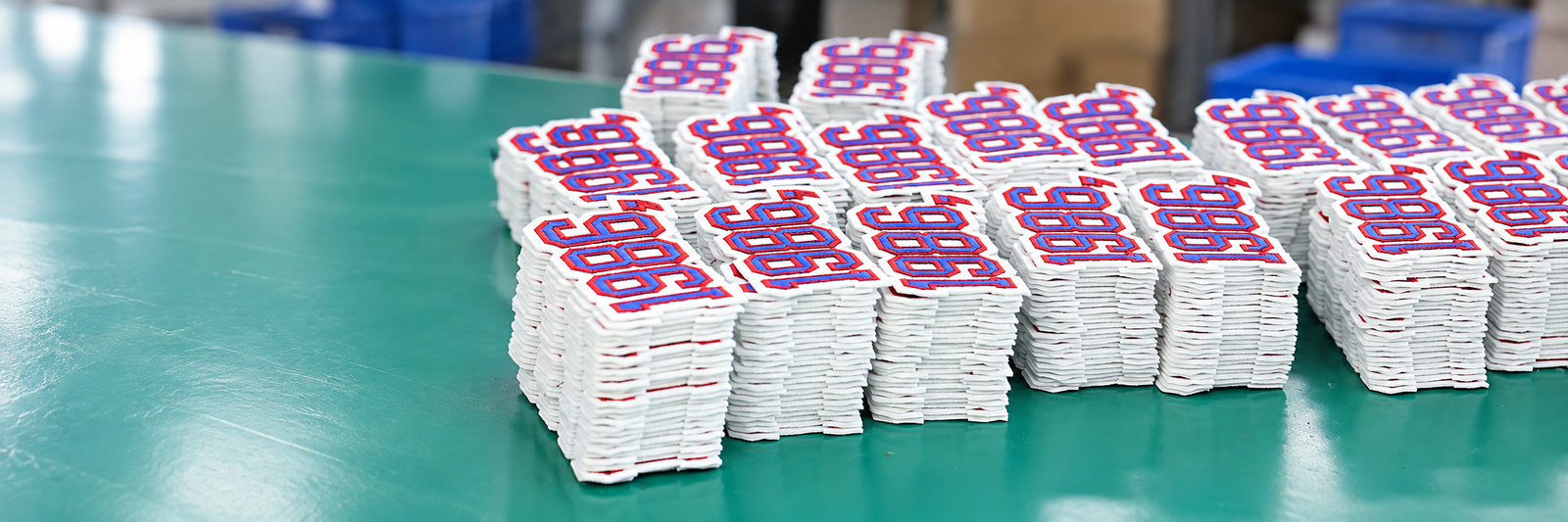
The standard
A sample is the specification, not a preview.
Every check on this page is measured against this one document set — never against a memory of the last run.
- With a physical sample
- Production standard = final production artwork + the approved physical sample. That pair, not a description of it, is what the bulk run is measured against.
- Without a physical sample
- Production standard = the final approved production artwork. Production is released on that version and not on an earlier one.
- Colour reference
- Pantone is the production reference, backed by thread colour cards, PVC colour samples, material samples or a physical sample. Thread, PVC, material and screens differ from each other, so no 100% colour identity is promised across materials.
- Structure
- Material, finished size, thickness, backing and intended application, confirmed together before mass production rather than discovered on the run.
- Packing requirement
- Packing method, label, barcode, SKU and carton mark held with the order, so the packing re-check has something to check against.
Without an approved standard, the most expensive question in custom manufacturing is not "is this piece good?" but "good compared with what?" — which is why the approved sample, the artwork version and the colour reference are kept, not just remembered. How sample approval works.
Inspection points
Six checkpoints between artwork and carton.
In the order they happen. The first three are gates: the run does not continue past one until it is approved.
-
01
Artwork review
-
02
Sample approval
-
03
First-piece approval
-
04
In-process inspection
-
05
Finished-goods inspection
-
06
Pre-packing review
A finished-goods check only sees what is still visible at the end, which is why artwork review and first-piece approval sit in front of it: the cheapest defect to fix is the one caught before the rest of the run repeats it. How an order runs, stage by stage.
Inspection depth
Depth follows the risk, not a habit.
Piece by piece
Sampling
The checkpoints do not move
We publish no AQL figure and no defect percentage, because the material we work from does not define one: the depth of inspection is agreed per project and written into the order. What does not move is the last gate — anything unresolved at the pre-packing review stays in the building.
What is inspected
The checks are written down because they are made.
The inspection points below are the ones our own quality procedure lists, in the two languages it is written in.
| Checked | Compared with | Checkpoint |
|---|---|---|
| Colour matching | Thread, PVC or ink matched to the reference you supply — Pantone, a thread card or a physical swatch — for the whole run, not only for the sample. | Sample → finished goods |
| Thread colour | The thread the specification calls for, matched for the whole run and not only for the sample. | First piece → in process |
| Logo proportion | Mark size and position against the approved artwork, at the finished size. | First piece → finished goods |
| Small-text clarity | Whether the smallest letterform still reads at the size you ordered. | Artwork review → sample |
| Woven detail | Letterforms, fine lines and dense artwork in the weave. | Sample → finished goods |
| PVC layering | Layer definition, colour separation and edge quality on moulded work. | Finished goods |
| Embroidery stitching | Stitch direction and density, and how the stitched edge holds at finished size. | In process → finished goods |
| Edge finishing | A merrowed border or a contour cut taken clean along the artwork outline on the vision cutters. | Finished goods |
| Finished size & thickness | Dimensions and material thickness against the agreed specification, measured on the finished piece rather than assumed from the artwork file. | First piece → finished goods |
| Material consistency | The material the sample was made in, held across the run rather than swapped for a close equivalent. | First piece → finished goods |
| Adhesive, iron-on & hook-and-loop | Attachment and backing strength for the structure you chose — the backing is checked, not assumed from the name on the packing list. | Post-finishing → finished goods |
| Quantity & packaging | Quantity counted to the order and packed to the agreed method, with label, barcode, SKU and carton mark. | Pre-packing review |
| Bulk consistency | The last piece against the first, and this run against the one before it. | Throughout the run |
Size and thickness are checked against the specification agreed before production, not against a guess at the bench. Where a process carries a reasonable production tolerance, it is stated and agreed with you before the order — never disclosed after the run. What we need to quote accurately.
When something does not match
It is fixed here, or it does not leave.
The rule is short: a piece that fails is taken out of the run, and it is never counted as quantity.
-
01
Taken out of the run
-
02
Remade to the full quantity
-
03
Or agreed with you first
-
04
Never mixed in
Anyone in the chain can stop a run: sales, merchandising, production or QC can each raise a pause where a risk appears, and work resumes only once the cause is resolved and confirmed internally. A change to design, colour, process, lead time or cost after the run has started is re-confirmed with you before production continues — it is never run through quietly.
Repeat orders
The second order is measured against the first.
Consistency is a record, not an intention — and it is built before the first run, not after it.
Held against the project
- The approved sample
- The physical piece you approved is archived, so a reorder is measured against an object rather than a description or a photograph.
- Artwork versions
- Customer requirement, final artwork and production artwork kept as the approved version, separated from the versions that were superseded.
- Colour requirements
- The thread, PVC or material colour reference the run was matched to, so the next run starts from the same reference.
- Material, size, backing & process
- What the piece was made of, how big it finished, how it attaches and which line produced it.
- QC requirement
- The inspection agreed for that project, so the next run is checked the same way as the last one.
- Packing requirement
- Packing method, label, barcode, SKU and carton mark, so a top-up sits beside the first delivery instead of merely near it.
- Repeat-order record
- What the previous order was produced and packed as — the reason an identical reorder reuses the record, and a changed one is re-confirmed before production.
Where a reorder is identical in design, colour, size, process, backing and packing, the historical record is used and the run is not re-invented. Where any one of those changes, the changed part is re-confirmed before production — a reorder is neither a fresh guess nor an automatic copy.
Verify it yourself
Three things you can ask us for.
Inspection you cannot see is inspection you have to take on trust. These three you can hold.
-
01
Approve a physical sample, and keep your signed piece
-
02
Ask what the run will be produced to
-
03
Ask for bulk photos, videos and packing photos before dispatch
Your own incoming inspection is only as strong as the standard behind it: a signed sample and a written specification are what let you check a delivery in your warehouse the same way we checked it here. Samples & approval · Frequently asked questions.
Keep exploring
The pages a buying team opens next.
Each one covers a single part of what is summarised above.
- Factory & Manufacturing The floor and the equipment
- Packaging Retail, neutral & white-label
- Samples & Approval How the standard gets set
- How We Work The order, stage by stage
- Lead Times & Rush Orders Timing and rush review
- Artwork Requirements What we need to quote
- Custom Patches What these checks apply to
- Frequently Asked Questions MOQ, lead time, shipping
Talk to the people who will inspect your order: Bella · +86 183 1957 4312 · info@lovecolour.com.cn · 5th Floor, No. 2 Siheng Road, Hebei Datian, Hebian Helong Street, Baiyun District, Guangzhou City, Guangdong Province, China, 510000
Page last updated · Written and maintained by the LOVECOLOUR production and QC team in Guangzhou, from our own quality procedure
Direct factory collaboration
Send the artwork. We will tell you how it will be checked.
Include the end use, the colour reference, the backing and the packing requirement. You get the process recommendation, the inspection points for your product and a factory-direct quote.