Flat embroidery
Even satin and fill stitches at a standard density — the everyday base for logos, lettering and borders.
The making
Five stages, each with an owner and a record. The sample you approve is what every piece in the run is measured against.
Proportion, small text, fine lines, stitch direction and density are checked at the finished size before anything is quoted.
Your artwork becomes a stitch file: stitch direction, density and thread colours set for the substrate it will sit on.
A physical sample comes off the machine for your approval — often inside 2–3 days when capacity allows.
Approved work runs on 50+ computerized multi-head machines: flat, high-density, metallic, sequin and multi-colour.
Backing laminated, edges cut on 30+ vision-guided machines, then inspected against the sample you approved.
Stitch vocabulary
Stitch type, density, thread and substrate decide how the surface reads — and what the artwork can carry.
Even satin and fill stitches at a standard density — the everyday base for logos, lettering and borders.
More stitches, more build. Dense fills read as solid colour, and raised lettering stands proud of the fabric.
A reflective finish for crests, anniversary badges and heritage-style lettering.
Selected sequin and special-effect work, usually applied as an accent inside a stitched design.
Multi-colour thread work, and embroidery combined with woven, PVC, laser-cut or printed elements in one piece.
Contour outlines, letters and inside cut-outs, cut on the outline instead of by hand.
Detail limits
Thread has a width. The limit moves with the substrate, the stitch direction and the size of the piece, so it is checked on your artwork rather than published as one number.
The same artwork stitched at two sizes: open letterforms on the left, filled-in counters on the right.
Artwork review checks the smallest element at its finished size. If embroidery cannot hold it, we say so and recommend resizing, simplifying the design or switching to woven or PVC — instead of producing a specification that cannot work.
What artwork review checks
Too fine for thread? The same artwork can be produced as a woven patch instead — decided at review, before a sample is cut.
Applications
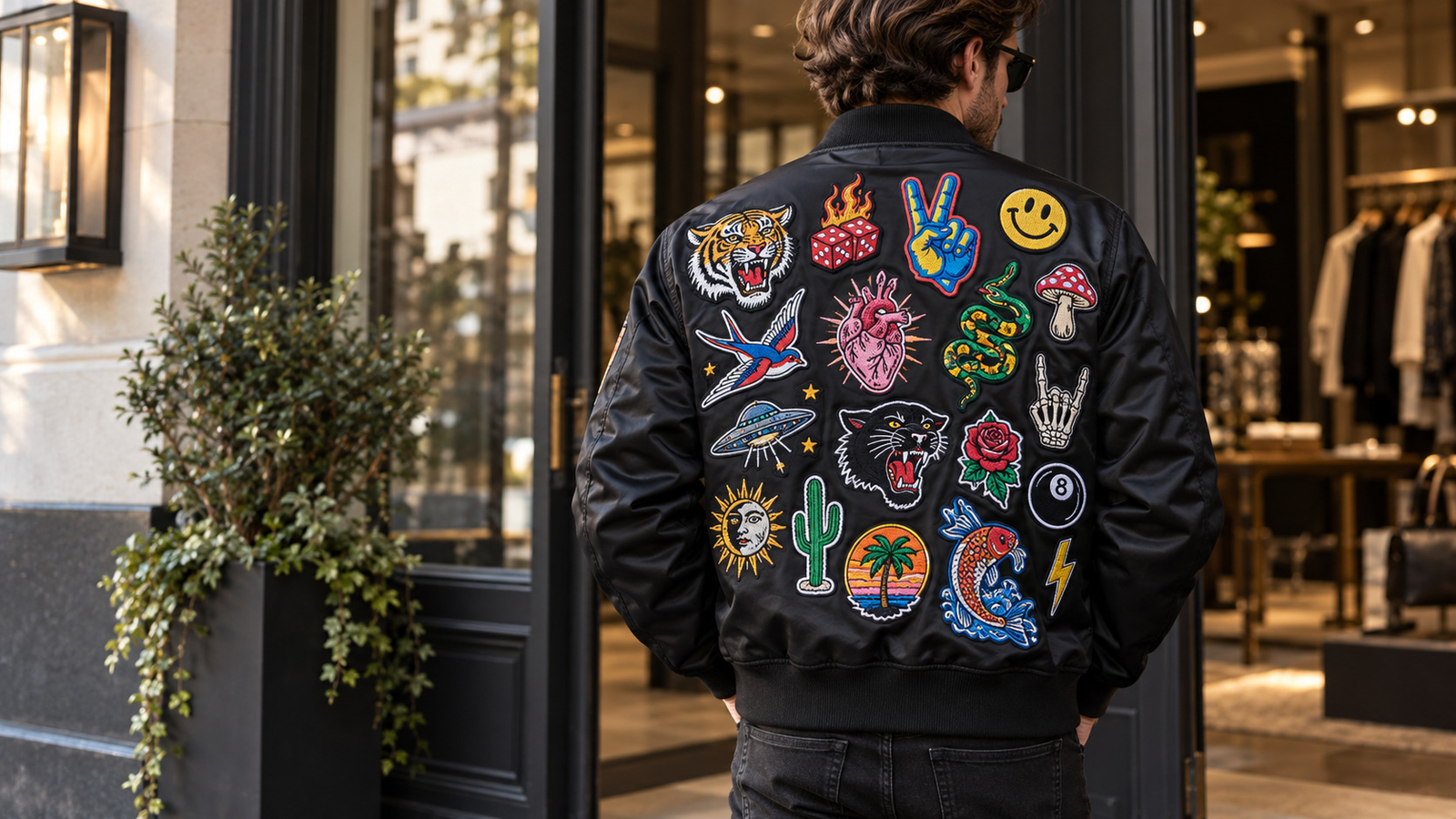
Textiles that get worn: headwear, uniforms, outerwear, bags and team programmes.
Front panels, side flashes and closures.
Name badges and department marks that survive laundering.
Large formats, sleeves and hem tabs.
Patch areas, molle panels and haul loops.
Letter patches, team sets and tournament editions.
Embroidered keychains and lanyards on the same lines.
البنية
Four backings and two edge finishes cover almost every application. All of them are confirmed on the spec sheet before sampling.
Heat-activated adhesive film, applied with a heat press.
Hook side on the piece, with matching loop tape supplied.
Pressure-sensitive backing for temporary use on hard surfaces.
Plain fabric back, no adhesive. The most durable option.
A thread-wrapped edge sealing the perimeter, for circles, shields, ovals and rectangles.
Cut on the outline by our 30+ vision-guided machines, for irregular shapes, lettering and inside cut-outs.
Manufacturing
Embroidery runs on the same floor as digitizing, cutting, finishing, inspection and packing — a 7,000 m² facility in Guangzhou rather than a subcontracted job.
Embroidery, cutting, finishing, inspection and packing in one building.
Digitizers, machine operators and finishing teams working from one specification.
Computerized multi-head machines for flat, high-density, metallic and multi-colour work.
Camera-guided contour cutting for irregular shapes and lettering.
The sampling bench: a stitch-out is checked against the artwork before bulk.
Computerized multi-head embroidery machines, running patches, keychains and lanyards on the same floor.
Finishing and inspection: trimming, backing, colour and quantity checked against the approved sample.
Keep exploring
The embroidered range carries the specification; the process and procurement pages cover material choice, artwork, samples and dates.
Page last updated · Maintained by the LOVECOLOUR artwork and digitizing team in Guangzhou
FAQ
Short answers to what buyers ask before sending artwork. Anything project-specific is confirmed in writing at review.
Each product carries its own standard MOQ, and for many custom items it starts at around 100 pieces. It is confirmed for your specification, because the size, stitch count, thread colours and backing all move it. Below the standard MOQ the unit price can increase.
It reproduces the shapes and colours faithfully; it does not reproduce gradients or hairline detail, because thread has a width. Send the artwork with its finished size and artwork review will say whether embroidery holds it or recommend woven, PVC or printed instead — rather than producing a specification that cannot work.
Vector artwork — AI, PDF, EPS or SVG with fonts outlined — is ideal, and a high-resolution raster file also works. Our digitizers rebuild it as a stitch file with the stitch direction, density and thread colours set for the substrate it will sit on.
Bulk production usually takes 7–12 days after artwork approval, and a stitch-out sample can be ready in about 2–3 days when capacity allows. Rush orders are reviewed case by case against production capacity, material, artwork status and shipping method, so a rush date is confirmed rather than promised.
It depends on the structure, which is why the backing is confirmed before sampling. Iron-on and heat-seal performance, adhesive and hook-and-loop attachment, stitching and thread colour are all inspection points, and garments that are laundered heavily usually call for a sew-on back or a stitched perimeter in addition.
Direct factory collaboration
Include the finished size, quantity, substrate and backing you have in mind. We review the detail, recommend the process that holds it, and come back with a factory-direct quote — or tell you plainly that embroidery is not the right process for the job.