Stage by stage
Idea → engineering → sample → production → QC → delivery → repeat.
Ten stages, in the order they run. Under each one is the rule that keeps it honest — the reason a stage cannot be skipped, and the reason the second order is easier than the first.
-
Step 01
Artwork & requirement review
- You send
- The logo or artwork file, the product type, the size, the quantity, the material and backing, the packaging requirement, the application and the date you need it in hand.
- We do
- Read the file against the process it would be made by: logo proportion, small-text clarity, fine-line feasibility, stitch direction and density, thread colour, border structure, finished size, backing and cutting line — and, for PVC or rubber, layer definition, line width and edge quality.
- You get
- A process recommendation, and a plain statement of what the artwork can and cannot carry at the size you need. Where standard embroidery will not hold it, we propose adjusting the size, simplifying the artwork or switching to a woven, PVC or other route rather than producing a specification that cannot work.
- The rule here
- Nothing is quoted from an unread file, and a quick reply is never an inaccurate rough price. In working hours the first response is within the hour, and it says what is being checked and what is needed next.
-
Step 02
Engineering & digitizing
- You send
- Nothing new — the file from step 01. A photograph of anything you have already approved is useful, so the build starts from it rather than from scratch.
- We do
- Build the production file for the chosen process: stitch direction and density for embroidery, layer build and line width for moulded work, and the cutting line for the outline, held against the specified material, backing and finished size.
- You get
- Production artwork and a digital proof — the base confirmation on which everything physical is built.
- The rule here
- Every artwork is version-controlled. Only the final approved version can reach the line; an older version cannot.
-
Step 03
Quotation & confirmation
- You send
- The quantity range you are planning, the destination country, and any packing, labelling, barcode or SKU requirement the order has to carry.
- We do
- Quote in quantity tiers so the relationship between quantity and unit price is visible — 100 / 500 / 1,000 pcs is the usual example and the actual tiers follow the product — and keep the charge lines apart: product price, sample fee, mould or setup fee, special packaging, freight and any other special charge.
- You get
- A written quotation with a 30-day validity. Once it has expired, material, labour, quantity, FX, freight and capacity are re-confirmed instead of being silently carried over.
- The rule here
- An agreed price is not an order. A confirmed order needs the final specification, quantity, process, backing, packaging, lead time, price and payment terms — and the agreed payment received.
-
Step 04
Sample approval
- You send
- Your comments on the sample, against the digital proof and the finished size.
- We do
- Produce the physical sample where the work calls for one: a new design, complex artwork, dense small text, high colour requirements, a special material or process, a large order, an important event or a high consistency requirement. Custom samples are normally charged, and any reduction or offset against bulk is approved before it is promised.
- You get
- An approved sample that becomes the standard for the bulk run, recorded against the order file so a repeat can be quoted from it.
- The rule here
- With a physical sample the production standard is the final production artwork plus the approved physical sample; without one it is the final approved production artwork. Neither standard is a verbal approval.
-
Step 05
Production release
- You send
- Any specification detail still open, and confirmation of the delivery requirement.
- We do
- Check the gate before the order is released: order information complete, final artwork ready, sample or artwork approved, payment status meeting the agreement, delivery requirement confirmed.
- You get
- A release — and the moment the production clock starts.
- The rule here
- Incomplete production data blocks release even after payment. The order file is completed and reconfirmed first, then released.
-
Step 06
Bulk production
- You send
- Nothing — unless something in the specification has changed, in which case it is raised before the run, never during it.
- We do
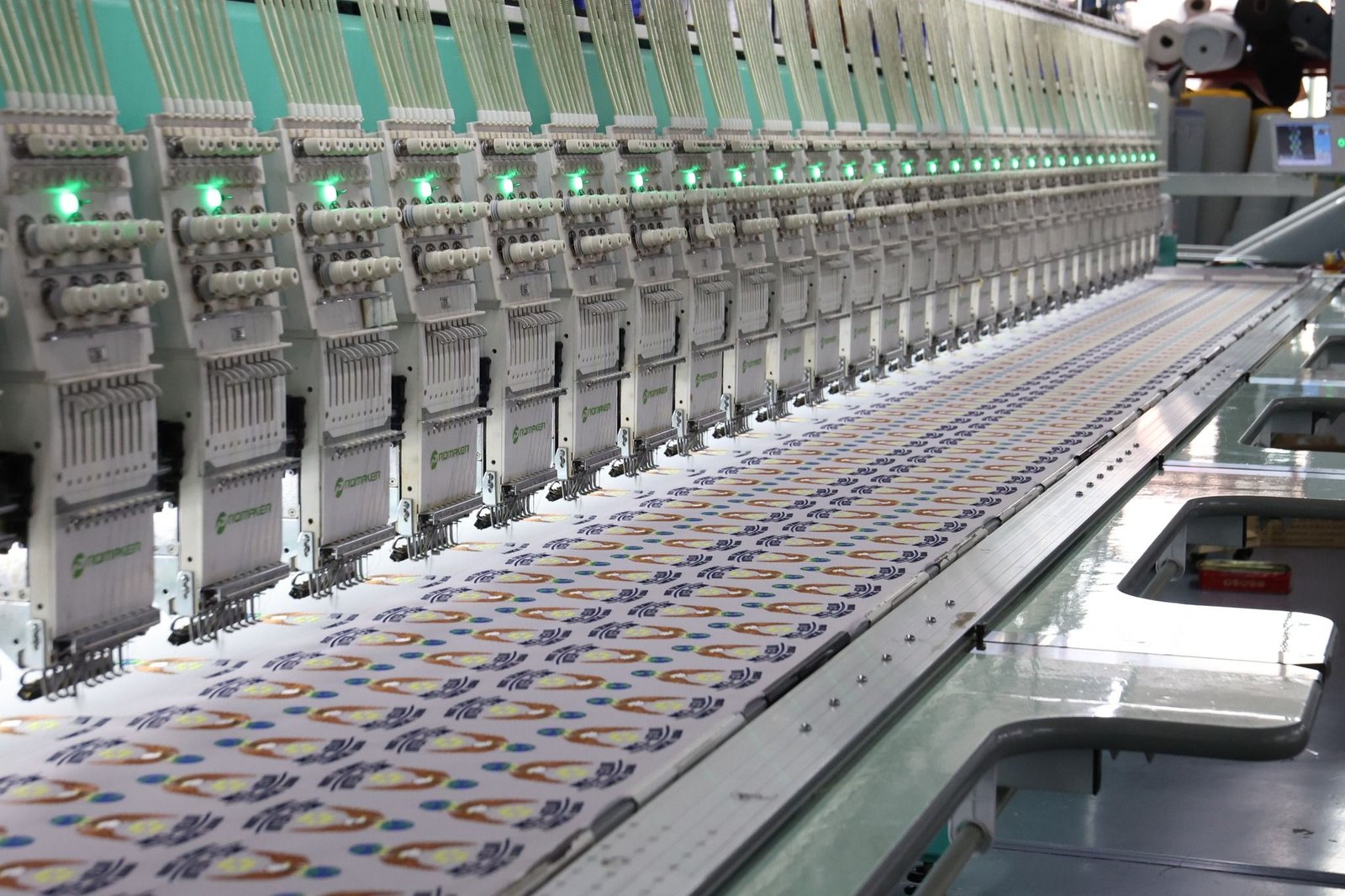
- Run the approved program: embroidery, weaving, moulding or print, then backing lamination, heat press, edge cutting and assembly, across 50+ large high-precision computerized embroidery machines and 30+ vision-guided cutting machines.
- You get
- The full order quantity, produced from the approved file and the approved sample rather than from an interpretation of them.
- The rule here
- The lead time counts from the release in step 05 — not from the first inquiry, the first logo sent, the first quotation or a verbal OK.
-
Step 07
Quality control
- You send
- Any acceptance criteria the order has to meet: colour, size, detail, edge, backing, packaging and the bulk consistency your brand requires.
- We do
- Inspect at four points — first piece or first batch approval, in-process inspection, finished-goods inspection and pre-packing review. First-piece approval is signed off by production, merchandiser and QC together, with sales joining on complex, high-risk or high colour requirement orders.
- You get
- A bulk run checked against the approved sample and the written specification, with inspection depth following risk: piece by piece for high-risk orders, complex product, key customers or product prone to individual defects, and sampling for mature, stable production — with process checks, finished-goods sampling and packing review in place either way.
- The rule here
- A defective piece is removed rather than counted as qualified, and it is remade to the full quantity. Unless a production tolerance was agreed before the order, the order quantity is delivered in full.
-
Step 08
Packaging & pre-shipment confirmation
- You send
- The final packing instruction: individual packaging, backer card, barcode, label, SKU, retail or neutral packing, and the carton mark.
- We do
- Run the packing review over quantity, packing method, label, barcode, SKU, carton mark, any special requirement and the order number — then photograph the result.
- You get
- Bulk photographs, videos, packaging photographs and quantity information sent to you after QC, so what is about to ship can be seen before it moves.
- The rule here
- Shipment is arranged after you confirm there is no obvious problem. This is the last point at which a query is cheap to answer.
-
Step 09
Delivery
- You send
- The consignee information and any documentation requirement the destination needs.
- We do
- Book the shipment and keep the record: shipping method, carrier, tracking number, ship date, ETA, consignee information and any logistics exception.
- You get
- Documents and tracking, with one communication window throughout: sales stays your single point of contact while logistics and the merchandiser work the case internally.
- The rule here
- Arrival is given as an estimated arrival, a delivery range and a risk disclosure — a production, shipping and buffer assessment first, never an absolute arrival date.
-
Step 10
Repeat order
- You send
- The previous order number, or the specification you were sent, plus whatever changes this time.
- We do
- Quote the same specification against the historical record, and reconfirm only the part that changed. Price is re-checked on material, labour, quantity, FX and freight: a small movement is absorbed to keep the price stable, and a clear one is explained before it is charged.
- You get
- A repeat that starts from an approved sample and an approved artwork version instead of from the beginning — which is what makes the second order easier than the first.
- The rule here
- Reorders are not chased on a fixed monthly rhythm. The reminder is timed from your order history, your consumption, your event schedule and your previous reorder cycle, and cross-selling stays within one or two related products.
The order file is what holds all of this together. A single order number links the quotation, the artwork version, the sample, the production file, the payment, the QC record, the packing instruction and the shipment; a multi-design order carries a master number plus one sub-number per design, so two SKUs on one purchase order cannot be confused at the packing table. Each sub-item keeps its own product type, design version, size, quantity, colours, material, process, edge, backing, packaging, sample status, final approved artwork and delivery requirement.
The rules
What a price, a sample and a date are decided by.
Six rules that answer most of what a buyer asks before an order is placed. They are written here rather than left to a conversation, because they are the same on every order.
Tiers for quantity, separate lines for everything else.
The sample becomes the standard, not a courtesy.
A lead time starts at release, and nowhere earlier.
What shifts a date, and what happens next.
Rush is confirmed by production, never promised by a reply.
Pantone is a reference, not a promise across materials.
A price and a schedule also depend on the order itself: each product has a standard minimum order quantity, limited flexibility is possible depending on the process, the customer and the order structure, and a below-minimum quantity can raise the unit price. Pricing & MOQ and Lead Times & Rush Orders take each of these rules further.
Changes & versions
Nothing is produced from a guess, and nothing is changed quietly.
This is the part of the process buyers ask about most. Five rules, each one written down because an order has already run into it.
-
01
One approved version, and it is the only one
-
02
A risk found after you confirmed
-
03
A change after bulk has started
-
04
A new idea after an approved bulk
-
05
Anyone on the floor can call a pause
Updates
Five points where you hear from us first.
An order should not have to be chased for news. These are the points we report at without being asked, and the one rule that covers everything else.
Reported without being asked
- Artwork and sample confirmed
- Bulk production started
- Production finished
- QC completed
- Shipment released
- Pre-shipment photographs and quantity
Anything that goes wrong is reported immediately rather than after a question — a delay, a material substitution, a logistics exception, anything that changes what arrives and when. One person carries it: sales stays your single point of contact from the first file to the delivery record, while the merchandiser, production, QC and logistics work the order between them.
That is also why the process survives a reorder. The artwork version, the approved sample, the colour references, the backing, the packing instruction and the delivery requirement stay attached to the order number, so the second order is quoted from what was already approved rather than reconstructed from a chat history.
Keep reading
One stage, one page.
Each guide below takes one stage of the flow above and answers it properly — what to send, what it costs, what a date depends on.
- Artwork Review What the file has to carry
- Samples & Approval Pre-production sample
- Pricing & MOQ What moves a quotation
- Lead Times & Rush Orders Dates & rush scheduling
- Global Shipping & Delivery Packing, documents & arrival
- Repeat Orders Why the second is easier
- Quality Control Inspection system
- Start a Project Send your artwork
Page last updated
Start here
Send the file and the brief, and the process starts.
Artwork, product, quantity, packing and the date you need it all reach the same desk. The first answer is a process recommendation and what the file needs — not a number pulled out of the air.