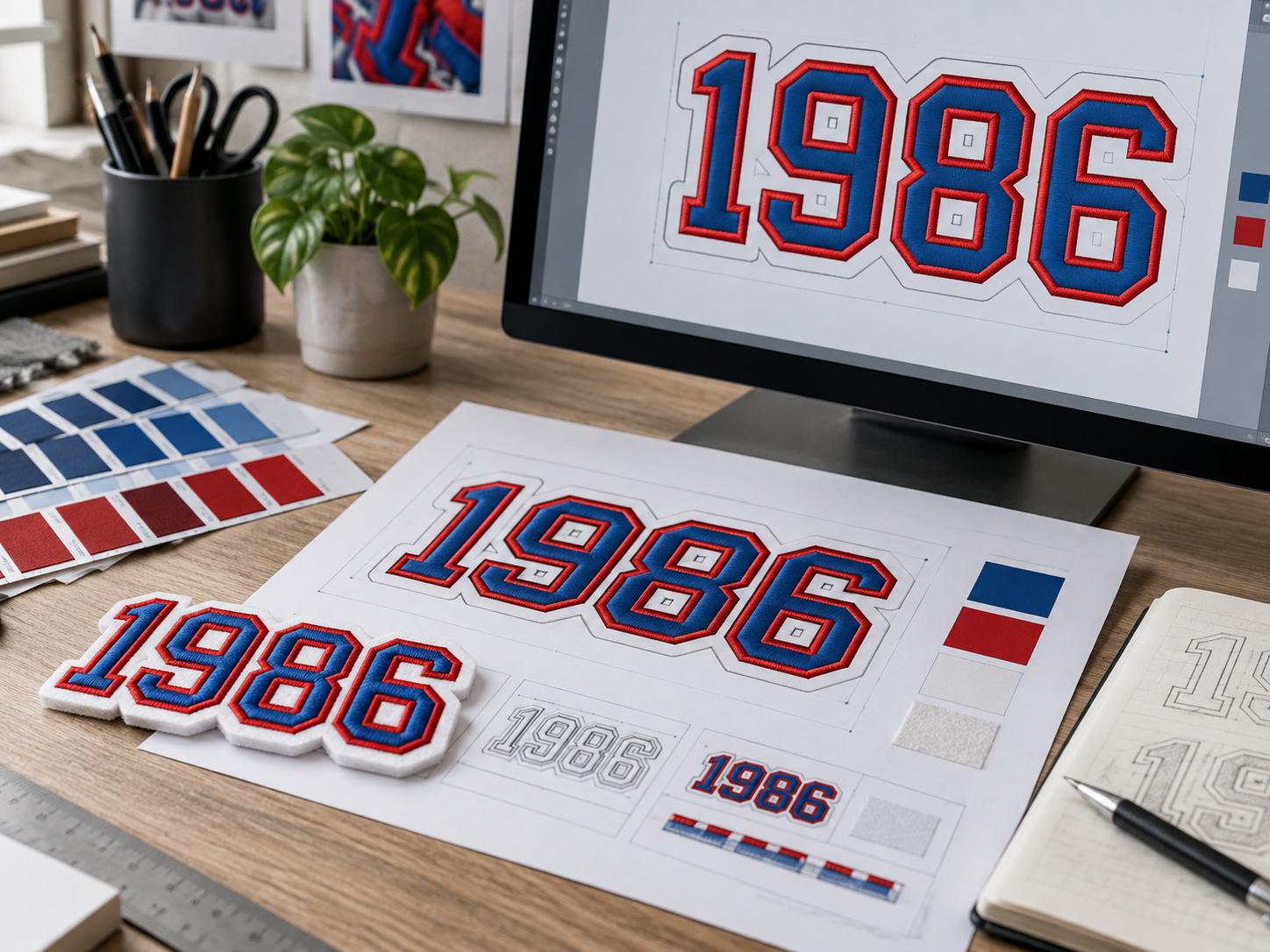
The file
Send the highest-quality version of the artwork you have.
That means the original master file rather than a screenshot, a photograph of a screen, or a copy that has been forwarded through a chat app and compressed on the way. If a logo, an image or a sketch is all that exists so far, send that: it is how most projects arrive, and which process suits it is the factory's judgement to make, not something a buyer is expected to know in advance.
Nothing has to be complete before it is sent. Whatever is missing is asked back rather than guessed at, and the file is read before a price or a sample is committed to — a quick reply is never an inaccurate rough number.
What the review needs beside the file
- Product type
- Size you need it at
- Quantity
- Material and backing
- Application or end use
- Destination country
- Packaging requirement
- Required in-hand date, for a dated project
If the piece is going onto apparel, kidswear, outdoor or tactical gear, or into a brand's own standard, say so with the file. Material, environmental, testing and certification requirements are confirmed before an order rather than after it — and if something is required that we cannot evidence, you hear that at review rather than at the packing table.
The review
The artwork decides the process, not the other way round.
Line weight, the smallest text, the border and the finished size are what a process is chosen from. Every point below is checked at the size you actually need, not from a thumbnail.
Stitched artwork, checked at its finished size
- Logo proportion
- Small-text clarity
- Fine-line feasibility
- Stitch direction
- Stitch density
- Thread colour
- Border structure
- Finished size
- Backing
- Cutting line
Moulded artwork, checked layer by layer
- Colour matching
- Layer definition
- Small-text feasibility
- Line width
- Surface effect
- Edge quality
- Product dimensions
- Backing strength
- Bulk consistency
Whether it holds, and in what.
A reference, and how it gets confirmed.
The review also settles the parts of a piece that are easy to leave undecided: the border structure and the cutting line for a stitched patch, the layer build for moulded work, and the backing the finished piece is applied with. All of them are part of the same check, because a beautiful file with no attachment decision is still not a producible specification.
Common problems
Six things that move a sample off course.
Buyers do not send bad artwork; they send artwork that has never been tested against a process. These are the six that come up most, and each one is answered before a sample is made.
-
01
Small text in a stitched process
-
02
Detail that only exists at one size
-
03
Colour that has to cross materials
-
04
Structure left undecided
-
05
An old version of the file
-
06
Tone rather than shape
The answer
Four steps from file to approved artwork.
A review produces something you can check, not an opinion. Each step below ends in a document, a proof or a physical piece.
-
Step 01
Feasibility & process recommendation
-
Step 02
Production artwork & digital proof
-
Step 03
Your confirmation, and the version that counts
-
Step 04
A physical sample where the work calls for it
What that leaves on the record: with a physical sample, the production standard is the final production artwork plus the approved physical sample; without one, it is the final approved production artwork. Neither is a verbal approval, and both are attached to the order number. Samples & Approval covers the sample stage itself, and How We Work places it in the ten-stage flow.
Keep exploring
The pages a sourcing team reads next.
Each one covers a single part of what is summarised above.
Direct factory collaboration
Send the file, and the brief around it.
Include the product type, the finished size, the quantity, the material and backing, the end use and the date you need the goods. The file is read and answered with the process that reproduces it — or with the change that would make it producible.