However, not every embroidered holder is suitable for every workplace. The right construction depends on the card being carried, the organization’s identification policies and the intended use.
This guide explains how to evaluate custom embroidered aviation crew ID badge holders before requesting samples or placing a bulk order with a manufacturer.
1. What Is a Custom Embroidered Aviation Crew ID Badge Holder?
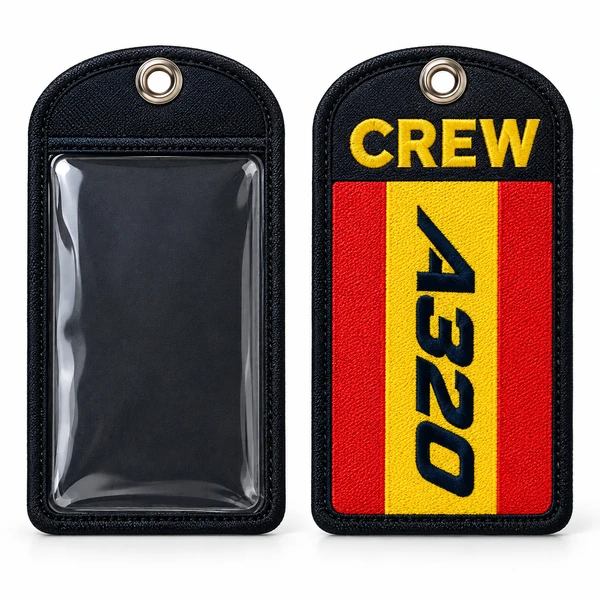
A custom embroidered aviation crew ID badge holder is a textile accessory designed to carry an identification card while displaying embroidered branding or team identification.
A typical construction may include:
- A polyester or nylon fabric body
- Custom embroidery on the reverse or a designated fabric panel
- A transparent PVC card window
- Reinforced stitched edges
- A metal eyelet for attachment
- An optional lanyard or compatible clip
Unlike conventional transparent plastic sleeves, fabric badge holders provide an additional surface for embroidered graphics, lettering and organizational branding.
For aviation-related projects, the embroidery might feature a crew designation, aircraft-inspired illustration, maintenance team label, national flag or authorized company logo.
The embroidered design is decorative and organizational. It does not replace an airport-issued identification credential or establish security access rights.
2. Why Choose an Embroidered Fabric Holder Instead of a Standard Plastic Sleeve?
Both textile and plastic badge holders can be useful. The better choice depends on the buyer’s priorities.
| Consideration | Embroidered Fabric Holder | Standard Plastic Holder |
|---|---|---|
| Branding | Textured embroidery, names and multicolor motifs | Typically printing or molded branding |
| Appearance | Distinctive textile presentation | Simple, functional appearance |
| Construction | Multiple sewn and assembled components | Varies from flexible sleeves to rigid cases |
| Customization | Fabric, embroidery, shape, hardware and stitching | Color, printing, shape and material |
| Cost Factors | Stitch count, fabric, sewing and assembly | Material, tooling, printing and quantity |
| Ideal Applications | Branded crew accessories and team merchandise | General-purpose ID display |
An embroidered holder is worth considering when the visual identity of a team matters. The embroidered surface allows a buyer to create a more distinctive accessory rather than relying entirely on a standard plastic card sleeve.
However, embroidery does not automatically make a holder more durable or more compliant with workplace requirements. Those factors depend on its specific materials, construction and testing.
For buyers considering alternative materials, our related product range includes custom plastic, PVC and premium badge holders.
3. Choosing the Right Fabric: Polyester vs. Nylon
The fabric body affects how a badge holder looks, feels and performs during manufacturing and use.
Polyester Fabric
Polyester is a practical option for many custom embroidered accessories. Depending on the weave and fabric specification, it can provide a consistent embroidery surface, a range of colors and suitable stability for stitched construction.
Polyester should be evaluated when the project requires:
- Consistent appearance across multiple designs
- Embroidered lettering and decorative graphics
- Coordinated fabric and thread colors
- Repeatable construction for bulk production
Nylon Fabric
Nylon is another possible choice, particularly where a specific woven texture, flexibility or abrasion-resistance requirement is important.
Actual performance varies significantly with fabric weight, weave, coating and finishing. Nylon should not automatically be considered superior to polyester solely because of its fiber type.
Fabric Weight and Structure Matter More Than the Fiber Name Alone
For an embroidered badge holder, buyers should evaluate how the fabric behaves after embroidery and sewing.
Important considerations include:
- Does the fabric remain flat around large embroidered areas?
- Will the stitches cause visible puckering?
- Is the fabric sufficiently stable around the eyelet?
- Can the material support the intended edge construction?
- Will the selected thickness make card insertion difficult?
Manufacturer’s recommendation: Confirm the exact fabric specification during sampling rather than selecting a material based on polyester or nylon alone.
4. Getting the Correct ID Card Size and Window Dimensions
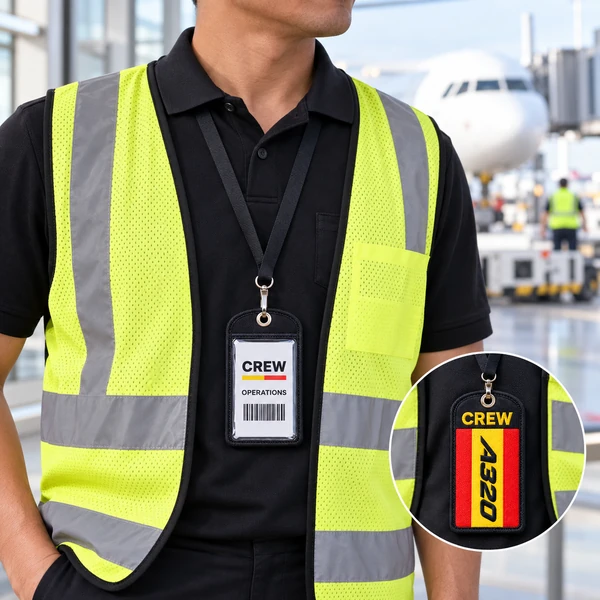
One of the most important technical decisions is ensuring that the intended ID card fits the holder correctly.
Understanding Standard CR80 Card Dimensions
The standard ID-1 card format, commonly called CR80, measures approximately 85.60 × 53.98 mm.
This format is associated with ISO/IEC 7810:2019, which specifies physical characteristics for identification cards.
However, CR80 describes the card dimensions, not the correct external dimensions of a fabric badge holder.
External Size vs. Internal Pocket Size
Consider a reference fabric holder measuring approximately:
- External width: 58 mm
- External height: 130 mm
- Finished thickness: approximately 3–4 mm
These dimensions describe one possible vertical design, not a universal standard.
The usable internal pocket must account for edge stitching, material thickness, seams and the card insertion opening.
A holder may appear large enough externally while still having insufficient usable internal width for a CR80 card.
For example, a card measuring 53.98 mm wide leaves only approximately 4.02 mm of total width difference inside a holder with an external width of 58 mm. Whether that is sufficient depends on the finished seam construction and internal clearance.
Therefore, the actual card should be physically tested rather than assuming compatibility from an external drawing.
What About the Clear PVC Window?
The visible window does not always need to equal the full dimensions of the card, but essential information must remain readable where the card’s function requires it.
Before approving production, check:
- Usable pocket width and height
- Card insertion and removal clearance
- Window placement and visibility
- Whether card corners catch on the stitching
- Whether the PVC creates excessive glare or distortion
- Whether the card remains appropriately positioned when worn
Practical buying tip: Send the manufacturer a physical sample of the actual card or a precise card drawing showing its dimensions, thickness and required visible areas.
If your project also requires printed credentials, explore our related range of custom PVC ID cards and badges.
5. Embroidery Design: Names, Flags, Aircraft Graphics and Small Lettering
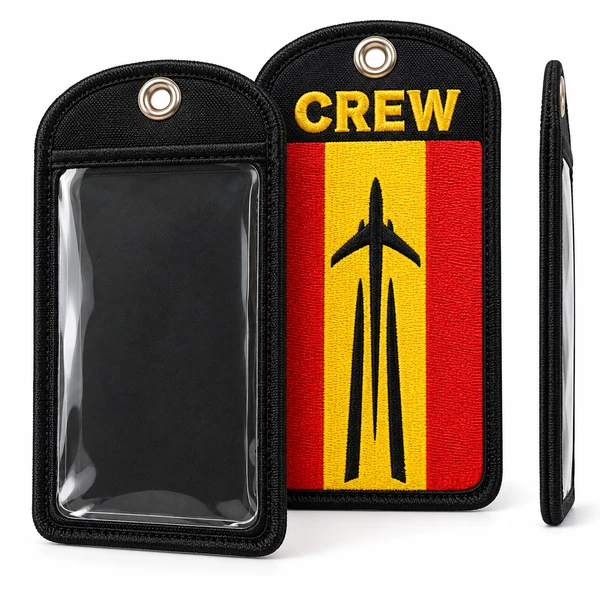
Embroidery can create a recognizable textile identity, but design details must be adapted to the available stitching area.
Crew and Department Lettering
Common examples include:
- CREW
- FLIGHT OPERATIONS
- MAINTENANCE
- GROUND TEAM
- TECHNICAL STAFF
For short labels, a bold and relatively simple letter style is generally easier to reproduce clearly than a highly decorative typeface.
The correct letter size depends on the embroidery thread, fabric texture, digitizing quality and machine setup.
Aircraft-Themed Graphics
Aircraft silhouettes, stylized model references and aviation-inspired geometric designs can be incorporated into the embroidered panel.
However, very fine lines, narrow spaces and highly detailed aircraft drawings may require simplification.
For example, an aircraft illustration that looks clear on a computer screen may lose important details when reduced to a small embroidery area.
Before production, the manufacturer should review:
- Minimum line thickness
- Stitch direction and density
- Spacing between design elements
- Embroidery area and overall scale
- Potential fabric distortion
Flags and Multicolor Embroidery
National flags and color-blocked artwork are frequently requested for team accessories and aviation-related merchandise.
Large embroidered color panels require appropriate stitch planning. Excessively dense stitching can affect fabric flatness and make the holder unnecessarily stiff.
Color matching also requires care. A Pantone reference is useful, but embroidered thread may not reproduce the appearance of printed ink exactly.
For important branding projects, buyers should approve thread colors using actual samples.
Embroidery vs. Woven Artwork
When a logo includes very small lettering or intricate details, woven production may be worth evaluating as an alternative.
Embroidery creates designs through stitches applied to a base fabric, while woven artwork incorporates a design through interlaced yarns.
The most suitable method depends on the design, size, construction and desired appearance.
6. Reinforced Edges, Stitching and Metal Eyelets
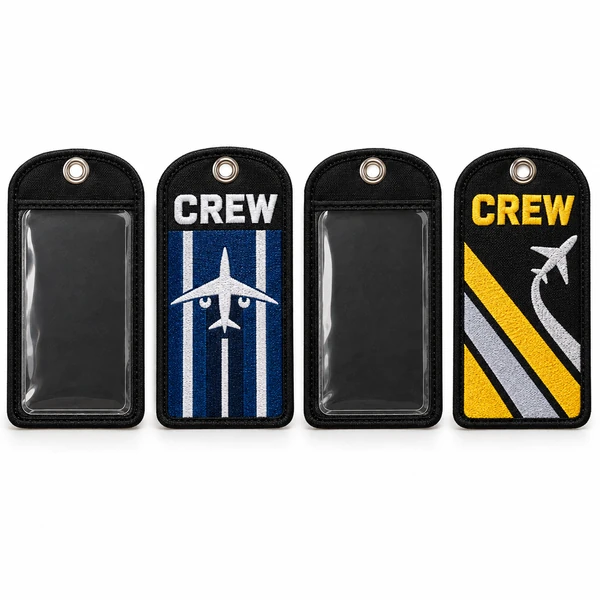
The surrounding construction has a significant influence on how the badge holder performs during daily handling.
Reinforced Edge Stitching
A well-designed edge finish connects the fabric layers while maintaining a neat and consistent outline.
Common problems buyers should watch for include:
- Uneven border widths
- Loose stitches around curved corners
- Puckering near embroidered panels
- PVC window misalignment
- Visible gaps between stitched fabric layers
Curved-top designs require particular attention because multiple materials meet within a relatively small area.
Metal Eyelet Selection
A circular metal eyelet is a common attachment option for textile badge holders.
For one compact vertical design, an eyelet with an internal diameter around 6–8 mm may be evaluated, but the final size should be selected according to the clip and the surrounding fabric construction.
Important inspection points include:
- Correct eyelet position
- Secure installation
- Smooth metal finishing
- Sufficient reinforcement around the hole
- Compatibility with the selected attachment clip
A high-quality appearance alone does not establish attachment strength. If the holder will experience repeated pulling, the buyer should agree on an appropriate physical test with the manufacturer.
7. Choosing a Lanyard and Attachment Method
An embroidered ID badge holder is often ordered together with a lanyard. Selecting the two components together helps avoid compatibility problems.
Common attachment options include metal swivel hooks, J-hooks, lobster-style clips and other compatible connectors.
For a complete custom identification accessory set, buyers can also consider:
- Polyester printed lanyards
- Woven or jacquard lanyards
- Detachable buckle options
- Safety breakaway connectors
- Coordinated fabric and branding colors
Learn more about the available constructions in our custom lanyard and ID accessory collection.
Important Workplace Safety Considerations
The most appropriate attachment depends on the working environment.
For example, maintenance workshops and areas involving moving machinery may have different lanyard safety requirements from an office or customer service desk.
A safety breakaway connector may be appropriate in some environments, but its use must be reviewed against the organization’s applicable safety procedures.
Likewise, the holder must not obscure mandatory information on an officially issued identification card.
For certain U.S. aircraft-operator environments, 49 CFR § 1544.231 addresses personnel identification systems, including the continuous display of identification media in specified secured environments.
Actual requirements depend on the airport, employer, jurisdiction and applicable security program.
Important: A decorative embroidered holder is not itself an approved security credential. Buyers should confirm whether additional holders, coverings or attachments are permitted before introducing them into a regulated workplace.
8. Can Different Aircraft or Crew Designs Be Combined in One Order?
Yes, combining different embroidered artwork versions may be a practical option when the holders share the same basic construction.
Consider a hypothetical order with two different embroidered aircraft-themed designs.
| Specification | Version A | Version B |
|---|---|---|
| Fabric | Black polyester | Black polyester |
| Outer Size | Same approved size | Same approved size |
| PVC Window | Same construction | Same construction |
| Metal Eyelet | Same hardware | Same hardware |
| Embroidery | Aircraft design A | Aircraft design B |
When the fabric, cutting dimensions, PVC window and hardware remain consistent, the manufacturer may be able to coordinate the two versions within one production plan.
However, the artwork still matters.
Different designs may require:
- Separate embroidery digitizing files
- Different stitch counts
- Additional thread changes
- Independent design approval
- Separate sample development
Combining the quantities does not automatically mean that two designs qualify for exactly the same unit price.
How to Request a More Useful Quantity-Based Quotation
Instead of requesting a single price, consider asking for several production scenarios:
| Order Scenario | Design A | Design B | Total |
|---|---|---|---|
| Small Trial | 25 | 25 | 50 |
| Initial Order | 50 | 50 | 100 |
| Medium Order | 100 | 100 | 200 |
| Bulk Order | 250 | 250 | 500 |
These quantities are illustrative buying scenarios, not guaranteed factory MOQs.
This comparison allows buyers to see how pricing changes as the overall quantity increases and whether combining design variants produces meaningful savings.
9. What Should You Inspect Before Approving a Production Sample?
A physical sample is especially valuable for a textile ID holder because its quality depends on the interaction between embroidery, sewing, PVC film and hardware.
We recommend evaluating the sample in four stages.
Stage 1: Visual Appearance
- Is the embroidered logo correctly positioned?
- Are the letters readable?
- Are the approved colors reasonably matched?
- Does the holder maintain the intended shape?
- Are the visible stitches neat and consistent?
Stage 2: Card Function
- Does the intended card fit into the pocket?
- Can it be inserted and removed without damage?
- Does the window show the required information?
- Is the clear film free from unacceptable defects?
- Does the card remain appropriately positioned when the holder is worn?
Stage 3: Construction and Attachment
- Are the stitched edges secure?
- Are the curved corners cleanly finished?
- Is the eyelet correctly installed?
- Does the selected lanyard clip fit properly?
- Are the material layers aligned?
Stage 4: Wearing and Handling
- Is the finished holder comfortable in the intended position?
- Does its thickness create unnecessary bulk?
- Does it rotate or twist excessively on the attachment?
- Does the construction interfere with required ID visibility?
- Is the accessory appropriate under the relevant workplace policies?
Buying tip: Keep one approved physical sample, the confirmed drawing and the embroidery artwork version as production references.
If changes are requested after sample approval, document them clearly before bulk manufacturing begins.
10. Understanding Sample Fees, Setup Costs and Bulk Pricing
Custom embroidered ID badge holders have several cost components. Evaluating these separately helps buyers understand why two products with similar dimensions may receive different quotations.
Embroidery Digitizing
Before embroidery production, suitable artwork must be converted into machine-readable stitch instructions.
Digitizing cost depends on the design complexity and the amount of preparation required. Different embroidery artwork files may involve separate setup costs.
Embroidery Stitch Count
A larger, densely embroidered design generally requires more stitching time than a small text logo, although machine configuration, thread changes and production efficiency also affect cost.
Fabric and Construction
Fabric specification, backing materials, transparent PVC thickness, cutting, edge finishing and sewing operations all contribute to the finished product cost.
Metal Hardware
Eyelet material, dimensions, finish, installation and optional attachment clips should be included in the quotation scope.
Prototype and Shipping Costs
Buyers should confirm whether the sampling quote includes embroidery preparation, finished prototypes, packaging and international sample shipping.
Any agreement to credit sample fees against a future order should be stated in writing.
Bulk Quantity
Higher order quantities can distribute certain setup costs across more pieces, but the final savings depend on material purchasing, machine time, design complexity and the manufacturing process.
For accurate comparisons, request quotations using the same approved specifications at each quantity level.
11. Buying from an Embroidered Badge Holder Manufacturer in China
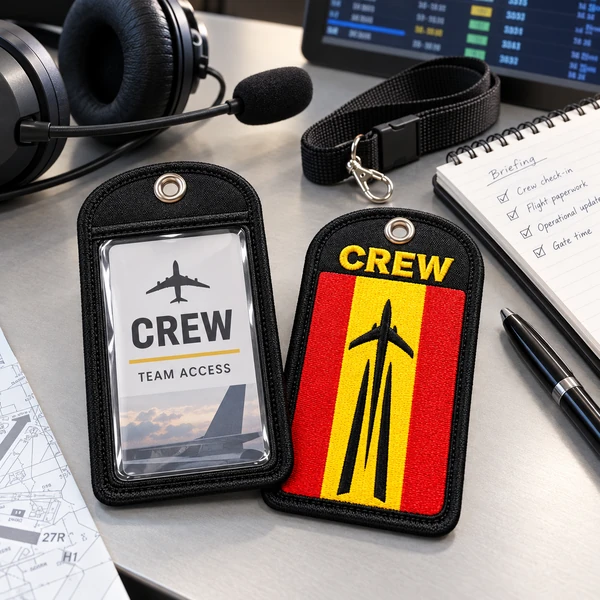
For international buyers sourcing custom embroidered aviation accessories, selecting a manufacturing partner involves more than comparing unit prices.
A useful supplier evaluation should cover:
- Technical understanding: Can the supplier identify limitations in the artwork or product drawing?
- Material options: Can the proposed fabrics and PVC window meet the intended construction?
- Embroidery capability: Can logos, text and colors be reviewed before production?
- Sample management: Can the supplier confirm what is included in the prototype quotation?
- Multi-design orders: Can different artwork versions be quoted transparently?
- Quality criteria: Can the buyer and supplier agree on an approved sample and inspection points?
- Lead-time transparency: Can sampling, production and international shipping be separated in the schedule?
- Packaging: Can the final goods be packed according to the intended distribution method?
Working with a Guangzhou Embroidery and Garment Accessories Supplier
Guangzhou is an established sourcing location for customized garment accessories and promotional products.
At Guangzhou Lovecolour Garment Accessories Co., Ltd., our work includes custom patches, embroidered accessories, labels and related OEM/ODM projects.
For custom fabric ID holders, our approach begins with reviewing the buyer’s artwork, required structure, material options and production quantity.
We then evaluate the appropriate manufacturing arrangement and sampling requirements before confirming a bulk production quotation.
Buyers from Europe, the United States, Australia and other markets should also provide their destination and shipping requirements so that suitable freight options can be evaluated.
EXW pricing may be used for the initial manufacturing quotation. Shipping arrangements, including DDP where available and applicable, should be evaluated separately based on the actual order and destination.
12. Common Mistakes When Ordering Custom Aviation ID Badge Holders
Several avoidable issues can increase costs or delay production.
Mistake 1: Assuming Exterior Dimensions Guarantee Card Compatibility
A badge holder’s external width does not equal its usable internal pocket width. Verify the actual card fit before mass production.
Mistake 2: Submitting Artwork with Excessively Small Embroidery Details
Tiny lettering and narrow lines can become unclear after embroidery. Ask for an embroidery feasibility review before approving the design.
Mistake 3: Ignoring the Eyelet and Clip Connection
Not every lanyard attachment is compatible with every eyelet. Confirm both components as one assembly.
Mistake 4: Assuming Multiple Designs Have No Additional Setup Costs
Shared construction may help production planning, but different embroidery files may still involve separate preparation costs.
Mistake 5: Focusing Only on Unit Price
A low unit price may exclude sampling, digitizing, packaging, accessories or shipping. Always clarify what is included.
Mistake 6: Treating Decorative Crew Branding as Security Authorization
An embroidered CREW label or aircraft graphic does not establish employment, identity or access permission.
Where official credentials are involved, the employer or airport authority must approve the complete wearing configuration and ensure that the required information remains visible.
13. Frequently Asked Questions
Are embroidered ID badge holders suitable for aviation maintenance teams?
They may be useful as branded team accessories or holders for permitted identification cards. Suitability depends on the workplace environment, safety procedures and applicable identification requirements.
Can different aircraft-inspired embroidery designs be ordered together?
Yes, combined ordering can be evaluated when the designs share compatible materials and construction. Separate embroidery digitizing and setup charges may apply.
Can a fabric badge holder fit a CR80 ID card?
Yes, a suitable holder can be designed for an 85.60 × 53.98 mm card. Actual pocket dimensions and card clearance must be verified with the intended card.
Is polyester or nylon better for an embroidered badge holder?
Neither is universally better. Performance depends on fabric weight, weave, finish, embroidery compatibility and intended use. Physical sampling is recommended.
Can we customize the embroidery colors to match our branding?
Yes. Available embroidery threads can be selected according to the artwork and color references. Exact visual matching should be checked through thread samples or prototype approval.
What information should we send to request a quotation?
Send the artwork, dimensions, intended card size, fabric preferences, quantity per design, attachment requirements, packaging needs and delivery destination.
Do embroidered crew badge holders provide airport security access?
No. The textile holder is an accessory. Official identification and access privileges are controlled by the responsible issuing authority and applicable security procedures.
14. Final Buying Checklist
Before confirming your order, make sure the following information has been agreed with the manufacturer.
- Approved artwork for every embroidery version
- Confirmed fabric type, color and construction
- External dimensions and usable card pocket size
- Transparent PVC window specification
- Embroidery area and thread color references
- Reinforced stitching and edge finishing
- Metal eyelet and compatible lanyard hardware
- Prototype cost and approval procedure
- MOQ and quantity per design
- Embroidery setup and tooling charges, if applicable
- Bulk production lead time
- Packaging and international shipping requirements
- Applicable workplace safety and identification policies
A complete technical specification helps reduce misunderstandings, unnecessary sampling revisions and avoidable production delays.
Request Custom Embroidered Aviation Crew ID Badge Holders from Lovecolour
Planning a custom aviation crew accessory, embroidered staff badge holder or multi-design identification project?
Lovecolour supports custom textile accessory development for brands, promotional product distributors, organizations and international B2B buyers.
Our team can review your artwork and help evaluate fabric construction, embroidery details, card window dimensions, metal attachment options and order quantities.
For product specifications and customization options, explore our custom embroidered fabric ID badge holders.
To request a quotation, please provide:
- Artwork or technical drawings
- Size and card dimensions
- Fabric and embroidery requirements
- Quantity for each design
- Required accessories and packaging
- Destination country and delivery requirements
Send us your project details and request a custom manufacturing quotation.