Patch Packaging for Retail, Events and Bulk Garment Production
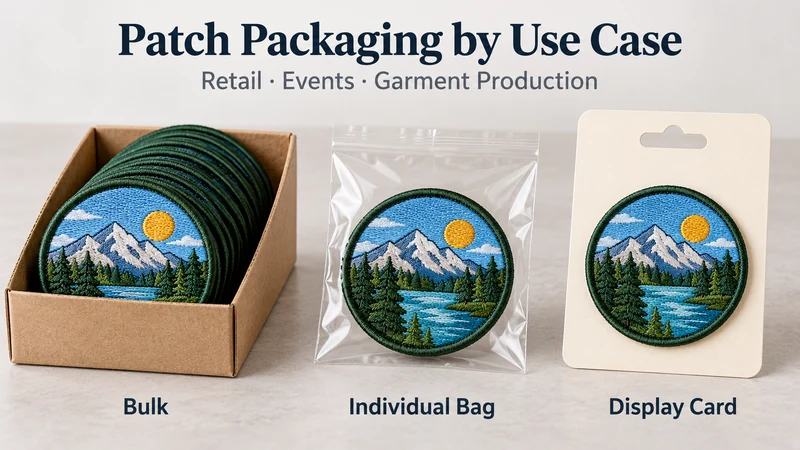
Choose patch packaging according to what happens after the carton arrives. Patches going straight to a garment production line need clear quantities and easy sorting. Patches sold individually need protection and room for customer-facing information. Event patches may need to be quick to count, move and hand out.
The patch itself can be perfect and the order can still cause trouble if designs are mixed, carton labels are unclear or retail information has nowhere to go. Decide the packing format while requesting the quote, then approve a packed sample along with the patch sample.
Which Packaging Format Fits Each Use?
| Destination | Packing approach to discuss | Main buying concern |
|---|---|---|
| Garment production | Standard bulk packing, separated and counted by SKU | Fast receiving and issue to the correct production line |
| Event distribution | Bulk groups or individual units, depending on handout method | Easy counting, transport and distribution |
| Individual retail sale | Individual bag or display-card concept, subject to supplier confirmation | Protection, presentation and product information |
| Multi-design assortment | Separate inner groups with clear SKU identification | Preventing designs or colorways from being mixed |
These are planning formats, not a promise that every supplier provides every pack style. Confirm the available materials, assembly work, minimums and charges for the format you want before including it in an approved purchase order.
For a garment factory, extra retail presentation may add work without helping the sewing team. For a shop display, a carton of correctly made but unidentified loose patches may create work at the buyer’s warehouse. Start with the use case.
How Should Different Designs Be Bagged, Labeled and Cartoned?
Give each patch design or variation its own SKU. A change in size, colorway, backing or artwork may be important enough to require a separate receiving identity, even when the front designs look similar.
Your packing instructions should answer:
- How many pieces go into each inner group?
- May different SKUs share an outer carton?
- If they share a carton, how will each group be separated?
- What information should appear on the inner and outer labels?
- Will quantities be recorded by SKU and carton, rather than only as one grand total?
A useful carton label identifies the purchase order, SKU or contained SKUs, design name, quantity and carton number. Agree on the exact fields with the supplier and receiving team. If one carton contains multiple SKUs, its contents should be unambiguous without opening every inner pack.
For example:
| Carton | SKU | Design | Inner-pack quantity | Carton quantity |
|---|---|---|---|---|
| [01] | [P-101] | [Mountain patch] | [Enter] | [Enter] |
| [02] | [P-102] | [River patch] | [Enter] | [Enter] |
The numbers are filled from the approved order, not guessed from a standard packing description. Send this format with the purchase order if your warehouse requires it.
What Information Needs Space on Retail Packaging?
A retail patch may need a product name, SKU, barcode, backing or application information and brand details. The exact content depends on the selling channel and destination market. Confirm those requirements with your retailer or compliance team before approving the card or label artwork.
The key design question is where that information will physically fit. A tiny patch on a small display card may leave too little room for readable copy or a scannable barcode. A bag label placed over the artwork may solve the data problem and create a presentation problem.
Prepare a simple retail mockup showing:
- The patch in its intended orientation.
- The front-facing brand and product information.
- The location of the SKU and any required barcode.
- The hang hole or display method, if applicable.
- The back of the pack, including any application instructions you intend to provide.
If a barcode is needed for point-of-sale scanning, supply the correct barcode artwork and confirm its placement and print quality against your retailer’s requirements. GS1’s barcode guidance is a useful starting point; a packaging mockup alone does not verify that a finished code scans.
Request confirmation that the proposed individual bag, card, label application or other retail assembly is available before finalizing the printed artwork.
How Can Packaging Make Sewing-Floor Receiving Easier?
A garment factory usually cares about finding the correct patch for the correct garment style and production batch. Packing should support that workflow.
If a brand orders three chest logos and two sleeve badges, do not send only a summary stating “five patch designs.” Identify the garment style or placement associated with each SKU. State whether the patches will be applied by the patch supplier, the garment factory or another decorator so the backing and packing plan make sense.
Ask the receiving team how they issue components to production. They may prefer separate inner groups by patch design, garment style or production batch. Confirm the count in each group and how partial cartons will be identified.
Also consider how the patches will arrive physically. They should be protected from unnecessary bending, pressure or mixing during transport. The appropriate method depends on the patch construction and shipment size; check a packed sample rather than relying only on a written phrase such as “standard carton packing.”
What Packaging Details Should Be Confirmed Before Quoting?
Packaging can affect materials, packing labor, carton use and shipping volume. Add it to the RFQ while suppliers are still quoting the product.
Use this checklist:
| Detail | What to tell the supplier |
|---|---|
| Sales channel | Retail, event, garment production or mixed use |
| Number of SKUs | Designs, sizes, colors and backings |
| Packing unit | Bulk group or proposed individual unit |
| Inner grouping | Pieces per group and whether SKUs may be mixed |
| Retail artwork | Bag, card or label files if required |
| Identification | SKU, barcode and carton-label data supplied by buyer |
| Carton plan | Required carton numbering and packing list |
| Sample approval | Whether you need to approve the assembled pack |
| Quote breakdown | Product price and any separate packaging or assembly charges |
Ask which requirements are covered by the quoted standard packaging and which proposed formats need separate confirmation and pricing. Do not assume that an individual bag includes a printed card, or that “retail ready” includes barcode creation and application.
FAQ
Is bulk packing suitable for patches that will be sewn onto garments?
Often it is a sensible format to discuss, provided the designs are separated, quantities are clear and the patches arrive in suitable condition. Confirm the details with the receiving garment factory.
Should event patches be individually bagged?
It depends on how they will be handed out. A staffed patch table may work well with counted groups; a pre-assembled giveaway kit may need individual units. Confirm whether individual packing is available and how it changes the quote.
Does an individual bag make a patch retail ready?
Not automatically. The retail channel may also require product identification, a barcode, application information or a particular display format. Confirm those requirements before approving the package.
Can several patch designs go in one carton?
They can if the order and packing method allow it. Keep each SKU clearly separated and provide a carton-level packing list so receiving staff know what is inside.
Who should supply the barcode and SKU data?
The buyer should provide the approved product identifiers and any required barcode artwork or specifications. Confirm with the supplier which labeling and application tasks it can perform.
When should I approve the packaging?
Approve it before bulk packing, ideally together with a finished patch sample. Check an assembled unit for individual presentation and a representative inner pack and carton label for bulk receiving.
Will custom packaging affect the patch MOQ?
It might have its own minimum or setup requirements. Ask for the patch MOQ and packaging requirements separately; do not assume one number covers both.
Package for the Next Person Who Handles the Patch
A retail customer, event worker and garment factory operator each need something different from the same patch. Write the packing instructions for that next person: what they should receive, how they will identify it and what they must do with it.
When requesting a quote, send the patch artwork, SKU list, intended use and packing requirements. Ask the supplier to confirm which formats it can provide and to show any packaging or assembly charges separately. For more guidance on preparing a multi-design order, browse the Knowledge guides.