PVC Keychain Hardware Explained: Rings, Chains, Clasps and Attachment Points
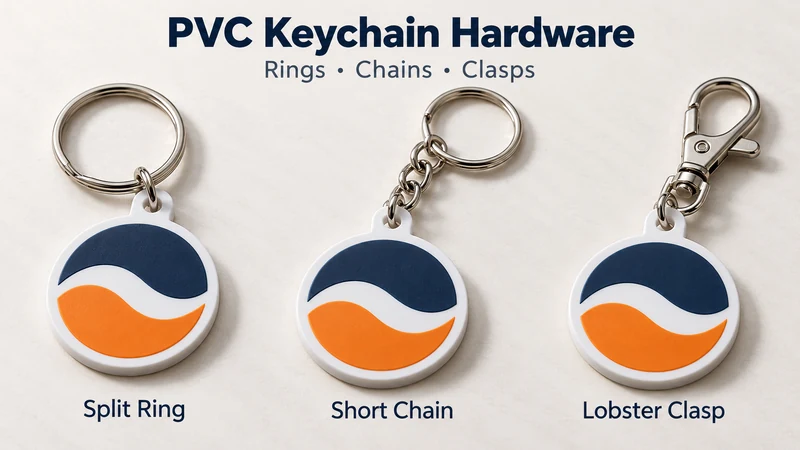
A split ring is a practical starting point for keys. A short chain adds hanging length and movement. A lobster clasp makes a PVC charm easier to clip onto a bag or removable loop. The right choice depends on where customers will use the item—and on how the hardware connects to the soft PVC body.
For a custom order, do not approve the molded design first and leave the attachment as “standard.” The ring, connector and attachment-point position determine how the finished keychain hangs, how easy it is to use and where handling force reaches the PVC. They belong on the artwork proof and in the sample review.
What Are Split Rings, Short Chains and Lobster Clasps Used For?
| Hardware | How it works | Suitable starting point |
|---|---|---|
| Split ring | A coiled metal ring holds keys or connects to another ring | Everyday keychains and compact promotional gifts |
| Short chain | Several links place distance between the PVC piece and the ring or clasp | A charm that needs more movement or hanging length |
| Lobster clasp | A spring-operated clip opens and closes for attachment | Bag charms, removable accessories and suitable zipper or bag loops |
A split ring gives customers a familiar way to add keys. Check its diameter against the intended use and confirm how it connects to the PVC piece. A split ring alone, a ring plus a small connector and a ring on a short chain are three different assemblies.
A short chain can help a large character or shaped logo hang below a bunch of keys or a bag attachment point. It also introduces more links that need to be checked. Specify the chain length and link style rather than requesting “a chain” without a drawing.
A lobster clasp is useful when customers are likely to move the accessory between bags or clip it onto a suitable loop. Check the clasp opening against the loop it must fit. An attractive clasp is of little use if its opening is too small for the intended bag hardware.
If the product is primarily a bag charm, describe it that way in the RFQ. If it must carry keys, say so. The same molded PVC design can need different hardware for those two uses.
How Does the Hardware Connect to the Soft PVC Body?
The metal hardware usually connects through a molded hole or loop, sometimes using a small metal connector between the PVC and the main ring or clasp. Some constructions may use an eyelet or another reinforced connection. The appropriate method depends on the keychain’s size, shape and intended use.
Review the connection as a complete assembly:
PVC body → molded attachment area → connector → ring, chain or clasp
A thick, attractive PVC design can still have a weak-looking connection if the molded loop is too narrow or the hole sits too close to the outer edge. Adding a larger ring does not solve a poorly positioned attachment point.
Ask the manufacturer to show the front and back of the attachment area on the production proof. On the sample, check whether the connector moves without twisting or cutting into the soft material. The purpose is not to choose the heaviest hardware available; it is to make the hardware and PVC body work together.
Why Does Attachment-Point Position Change How a Keychain Hangs?
A top-center attachment often makes a symmetrical design hang upright. Move the hole toward one corner, and the same PVC piece may tilt. That may be intentional for a character or angled logo—but it should be a design decision, not a surprise after molding.
Before approving the artwork, ask:
- Which side of the design should face forward when hanging?
- Should the piece hang upright, at an angle or freely rotate?
- Will the ring or clasp cover part of the logo?
- Is there enough PVC around the hole or loop?
- Does the proposed connector suit the thickness of the molded piece?
For an irregular shape, request a simple hanging-view mockup showing the complete hardware. Then hold the physical sample by its ring or clasp. A flat proof shows the outline; gravity shows the result.
Is Bag-Charm Hardware Different From Regular Keychain Hardware?
It can be. A conventional keychain usually prioritizes adding and holding keys with a split ring. A bag charm may prioritize quick clipping, visible presentation and the way the design faces when suspended from a handle or loop.
That changes the questions a buyer should ask. For a bag charm, confirm the clasp opening, hanging length and finished orientation against the intended bag attachment point. For a keychain, pay close attention to the ring assembly and how it handles repeated movement with keys.
Packaging may differ as well. A clasp can be positioned on a backing card for retail display; a ring and short chain may require a different card hole or bag size. Approve the assembled product in its packaging, not just the PVC piece photographed on a table.
Browse the custom keychains and small merchandise range when deciding which finished format fits your program.
What Should You Check Before Bulk Production?
A sample check should cover appearance and connection, because neither tells the whole story on its own.
- Match the approved specification. Check the PVC dimensions, colors, thickness, hardware type, finish, chain length and attachment-point position.
- Check the hanging view. Hold the item by the final ring or clasp. Does the design face the intended direction? Does hardware obscure the artwork?
- Inspect every connection. Look at the molded hole or loop, connector links, ring closure and clasp action. Check for obvious gaps, distortion or sharp contact with the PVC.
- Try the intended use. Add keys to the split ring or clip the clasp to the type of bag loop specified for the product.
- Agree on an appropriate strength check. If attachment strength is critical, ask the manufacturer what method and acceptance criteria will be used for this design. Do not assume that an unspecified “pull test” proves every use case.
- Review packed samples. Confirm that the selected hardware fits the individual bag or backing card without bending the PVC piece or tangling with other units.
For a repeat order, keep a sample and a record of the exact hardware assembly. “Same PVC charm” does not automatically mean the ring diameter, chain length or connector finish will be the same.
What Should You Put in the RFQ?
Send the PVC artwork and specify the finished width and height, expected quantity, intended use and preferred hardware. If you are choosing between options, request separate illustrations or quotations for each assembly.
A concise RFQ line could read:
Custom soft PVC keychain, finished size [width × height], [quantity] pieces. Intended use: [keys/bag charm/event merchandise]. Please quote [split ring/short chain/lobster clasp] and show the molded attachment point, connector, hardware dimensions, finish and hanging orientation on the proof. Please advise if the proposed connection should be adjusted before sampling.
Also state whether the back has artwork, whether multiple designs share the order and how each style should be packed. Ask the supplier to list any tooling or hardware-cost difference between versions rather than assuming all attachment options are interchangeable at the same price.
FAQ
What is the standard hardware for a PVC keychain?
A split ring is common, but “standard” can mean different ring sizes and connector assemblies. Confirm the actual hardware on the quote and proof.
Is a chain necessary between the PVC piece and the ring?
No. A chain is a design and use choice. It adds length and movement; a compact connector may suit a small keychain better. Compare samples if hanging position matters.
Is a lobster clasp better than a split ring?
It serves a different purpose. A lobster clasp is convenient for attaching and removing a charm from a suitable loop. A split ring is the familiar choice for holding keys. Some designs combine the two.
Can I change the attachment point after the PVC mold is made?
It may require a tooling or design change. Confirm the location on the proof before sample or mold approval, and ask the supplier about the cost of any later change.
Does a metal eyelet make every PVC keychain stronger?
No single component guarantees the strength of the complete assembly. The PVC shape, hole position, connector and intended handling also matter. Evaluate the finished sample as a system.
How do I know whether the clasp fits a bag?
Provide a photo or dimensions of the loop, handle fitting or zipper attachment where it will be used. Check the actual clasp opening on the sample.
What should be checked again on a reorder?
Confirm the approved PVC design and the ring or clasp type, connector, metal finish, attachment position and packaging. Keep the prior sample as a physical reference.
Make the Hardware Part of the Design Approval
The customer uses the complete keychain, not a PVC shape without its ring. Choose hardware according to the intended use, show the full assembly on the proof and test the way the sample hangs and connects.
If you are preparing an order, send your artwork and hardware requirements for a design-specific review. Include the intended application, size, quantity, preferred attachment and packaging so the sample reflects the product you plan to sell or distribute.