Custom Chenille Patches for Varsity Jackets: A Buyer’s Design Guide
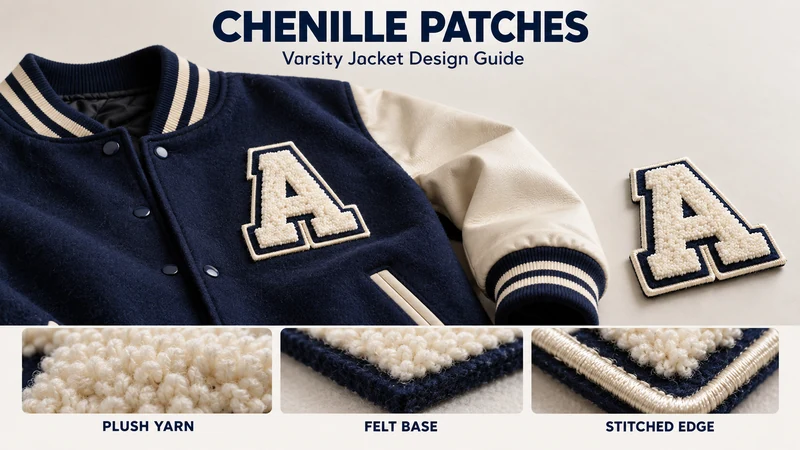
A good varsity jacket chenille patch is recognizable before anyone gets close enough to see the stitches. Its plush yarn gives a bold letter, number or graphic a soft, raised surface. The felt base and finished edge define the silhouette. Smaller features may need regular embroidery so they do not disappear into the texture.
For buyers, the design starts with the jacket—not a patch drawing viewed by itself. Decide whether the patch belongs on the chest, sleeve or back; check the space available on each jacket size; then develop the yarn, base, outline and attachment as one construction. A physical sample sewn or applied to the actual garment is the most useful approval reference.
What does a chenille patch look and feel like on a varsity jacket?
Chenille has a soft, raised, looped appearance often described as “towel-like.” It makes a large letter or simple shape stand out from the smoother jacket fabric. From a distance, viewers see the overall silhouette and color contrast. Up close, they see the plush yarn, the base fabric and the outline that separates one area from another.
That contrast is the reason chenille works so well for classic varsity styling. It also explains its main limitation: the plush surface needs room. A tightly packed slogan or detailed face may look clear in a digital file but lose definition when translated into small areas of yarn.
Our custom chenille patches can be developed around bold letters, numbers or graphics. The finished construction should be approved at its actual size and on its intended jacket fabric.
Which letters, numbers and mascots work well in chenille?
Block letters and large initials are strong starting points because their shapes remain clear under a textured fill. Numbers can work in the same way, provided their inner openings and strokes remain distinct.
A mascot needs a more selective approach. Give the largest recognizable area the chenille texture, then decide whether eyes, outlines or other small features need embroidery. Trying to reproduce every line of a detailed illustration in plush yarn can make the result look crowded.
| Artwork element | Chenille approach | What to check on the sample |
|---|---|---|
| Single varsity letter | Plush fill with a defined base and outline | Is the letter recognizable across the room? |
| Two-digit number | Bold strokes and clear inner spaces | Do both digits stay separate at the planned size? |
| Simple mascot | Chenille for the main shape; selected details in embroidery | Is its expression still recognizable? |
| Long school or brand name | Review as embroidery or another suitable method | Is every word readable at the finished size? |
| Thin decorative lines | Simplify, enlarge or use embroidery | Do the lines remain distinct beside the yarn? |
When planning a full alphabet, review more than one letter. A narrow I and a wide M may share a height but occupy very different space on a jacket. Approve the collection as a set so its letters feel related without forcing them into identical outlines.
How do the base fabric and edge change the patch’s shape?
A chenille patch has more than one visible layer. The yarn creates the plush area; the base fabric supports it and may remain visible around the design; the finished edge defines the outer shape.
Base color: An exposed felt border can increase contrast between the yarn and jacket body. Check it against both the chest fabric and any contrasting sleeves. A navy base on a navy wool body, for example, will read differently from the same base on a cream sleeve.
Visible border width: Too little visible base may blur the outline; too much can make the patch look larger and heavier than intended. Approve the proportion on a physical sample rather than assuming the digital outline shows the finished effect.
Edge finish: The chosen outer stitching or finish changes how crisp the letter looks. Inspect curves, corners and inner openings, where an uneven outline is easiest to notice.
Ask for a close-up of the sample and a full-jacket view. The close-up shows workmanship; the jacket view tells you whether the overall shape works.
What size should a chenille patch be on the chest, sleeve or back?
There is no single patch size that suits every varsity jacket. The available area changes with jacket size, pocket position, sleeve construction, seams and the design itself.
| Placement | Typical design role | Measure before approving |
|---|---|---|
| Left chest | Initial, team letter or compact emblem | Space between opening, armhole, pocket and seam |
| Sleeve | Number, small letter or secondary symbol | Usable panel width and position when the arm bends |
| Upper back | Team or brand name with a larger graphic | Space below the collar and between shoulder seams |
| Center back | Main mascot or statement artwork | Overall balance across the jacket’s size range |
Test placement on at least the smallest and largest jacket sizes in the order. A patch that fills the chest neatly on an XL jacket may crowd the pocket or armhole on a smaller size.
For a collection with multiple designs, specify each placement separately. “Same patch on every jacket” is straightforward; “same visual balance on every jacket” takes measurement and a sample.
When should chenille be combined with embroidery?
Use chenille for the broad feature that needs soft texture, and use embroidery where the design needs a sharper line. A mascot’s main body might be chenille while its eyes and mouth are embroidered. A large varsity letter might use chenille inside with an embroidered outline.
This is a design decision, not an instruction to add embroidery everywhere. Too many small embroidered elements can compete with the plush center. Mark the important details in the artwork and ask which ones remain clear at the intended size.
A simple production annotation could read:
Large letter: off-white chenille fill
Visible base: navy felt
Outer edge: cream stitched outline
Small year beneath letter: review as embroidery
Placement: left chest of navy wool jacket
The artwork review should resolve the relationship between those layers before sampling. Where the logo relies mainly on fine lines rather than plush shapes, compare it with an embroidered patch instead.
What attachment method suits the actual jacket?
Confirm whether the patches will be attached during jacket production or delivered loose for another facility to apply. Sew-on and suitable heat-applied constructions may be discussed, but the choice depends on the specific patch backing and jacket materials.
Varsity jackets can combine different fabrics on the body, sleeves and trim. Do not assume an application approved on one panel will behave the same way on another. A heat-sensitive sleeve material or a thick seam may change the plan. If heat application is proposed, test the approved patch on the actual garment with the specified equipment and settings.
For a sewn patch, review stitch position, seam access and the appearance inside the jacket. The attachment should hold the finished outline securely without distorting the wool body or crossing a pocket opening.
What should buyers inspect on the first sample?
Request a physical sample in the approved colors and place it on the intended jacket. Check it at normal viewing distance first, then close up.
- Shape: Is the letter or mascot immediately recognizable?
- Yarn: Is the plush fill even, with no unintended gaps?
- Base: Does its color and visible width support the design?
- Outline: Are corners, curves and inner openings clearly defined?
- Embroidery: Do the smaller stitched details add clarity?
- Size and placement: Does the patch fit the actual jacket and its size range?
- Attachment: Is the approved backing appropriate for the chosen fabric and application process?
- Colorway: Do yarn, base, outline, jacket body and sleeves work together under normal light?
Keep the approved patch and placement photograph as references for bulk production. A flat artwork file alone cannot show how the yarn, base and edge interact. See samples and approval for how the approved construction becomes the production reference.
How should you request a quote for a varsity jacket collection?
A factory needs the design breakdown, not just the total number of jackets. Send:
- Artwork and finished dimensions for each letter, number or mascot.
- Quantity by design and colorway.
- Jacket photos or samples, fabric details and size range.
- Placement for each patch: chest, sleeve or back.
- Chenille yarn, visible base and outline color references.
- Details to produce in embroidery, if any.
- Proposed attachment method and who will apply the patches.
- Packing instructions: grouped by letter, by jacket size or by complete set.
- Delivery destination and target date.
For example, “400 varsity patches” could mean one design in one color or twenty letters across several jacket styles. Those are different sampling, production and packing tasks. A clear breakdown helps the supplier quote the actual project and prevents the wrong letters from arriving in the right total quantity.
Review pricing and MOQ for the specifications that affect a custom patch quotation. You can then send your chenille project brief with the jacket reference and quantity split.
FAQ
Are chenille patches made from towel fabric?
Not necessarily. “Towel-like” describes the visible plush texture. Ask the manufacturer to confirm the actual yarn, base and finished construction on the sample.
Can chenille reproduce small letters?
Small letters need artwork review. Chenille is strongest when its textured areas have enough space to remain distinct. Embroidery or a different process may be clearer for small text.
Can one patch combine chenille and embroidery?
Yes, subject to design and sampling. Chenille can form the bold area while embroidery adds selected outlines or small details.
Is felt always visible around a chenille letter?
That depends on the approved construction. If you want a visible felt border, specify its color and appearance and check its proportion on a sample.
Should chest and back patches use the same dimensions?
Usually they should be planned separately. The available space and the role of the graphic differ. Check each placement against the actual jacket and size range.
Can chenille patches be heat-applied to any varsity jacket?
No. The patch backing, jacket materials and application conditions must be compatible. Test the proposed method on the actual garment before approving bulk application.
What information is most important for a mixed-letter order?
Provide the exact quantity of each letter, number, size and colorway, plus the packing method. A total quantity alone is insufficient for an accurate production plan.
Developing a varsity jacket line? Send LOVECOLOUR your artwork, jacket photos, placements and quantity breakdown. We can review which areas should be chenille, where embroidery would improve clarity and what the first sample needs to prove.