Sew-On, Iron-On or Hook-and-Loop Patches: How Should Buyers Choose?
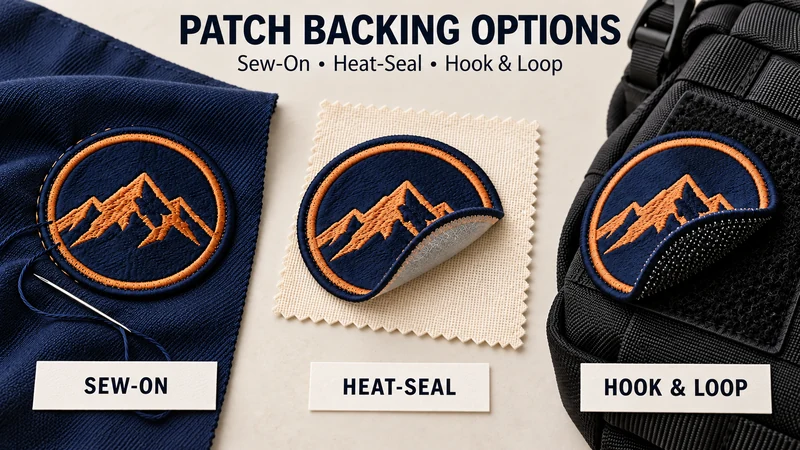
Choose sew-on when the patch should stay permanently on a product and the construction allows stitching. Choose iron-on, more precisely heat-seal backing, when the patch and the actual fabric have been approved for a controlled heat-press application. Choose hook-and-loop when the patch must be removed or exchanged and the product has a compatible receiving panel.
The patch face is only half the specification. The other half is the material underneath it: a cotton jacket, coated nylon bag and structured cap will not behave alike. If you are buying custom patches in volume, decide how the finished item will be worn, cleaned and handled before you select a backing.
How are the three patch attachment methods built?
| Method | Construction | Main advantage | Confirm before ordering |
|---|---|---|---|
| Sew-on | Patch with a suitable edge or sewing allowance, stitched to the product | Permanent attachment without relying on adhesive | Access for sewing, edge design, seam clearance and acceptable needle holes |
| Iron-on / heat-seal | Heat-activated adhesive film on the patch reverse, bonded under specified heat, pressure and time | Efficient application when the patch, adhesive and fabric are compatible | Fabric composition, coatings, press settings and wash testing |
| Hook-and-loop | Hook material on the patch reverse, with a matching loop panel on the product | Removable and interchangeable patches | Hook/loop pairing, panel size, attachment of the loop panel and snag risk |
“Iron-on” is the familiar search term, but professional production normally uses a heat press with controlled temperature, pressure and dwell time. A household iron may produce uneven pressure. Neither tool can make an incompatible fabric or coating accept an adhesive reliably.
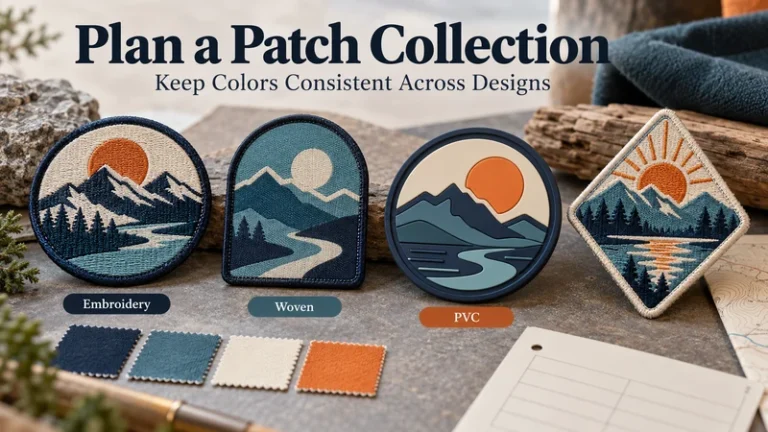
The patch type and attachment are separate choices. A buyer may first choose embroidered patches for their stitched look or PVC rubber patches for a molded finish, then review which backing is feasible for that specific design and application.
Which backing fits the fabric, wash routine and need to swap patches?
Start with three practical questions:
- Does the patch need to come off? If names, teams or campaign graphics change, a properly matched hook-and-loop system is the natural starting point.
- Can the product be sewn without damaging its function or appearance? If so, sewing offers a straightforward permanent attachment. Consider the inside finish and any waterproof layer that stitching would puncture.
- Can the exact fabric and patch tolerate heat application? Ask about fiber content, coatings, texture, thickness and care instructions. Then test the proposed adhesive and press process on the real product.
Cotton and many polyester garments are common heat-application candidates, but that description alone is not approval. Water-repellent finishes, some coated nylons, delicate fibers, heavy seams and uneven surfaces can affect adhesion or make pressing unsuitable. Similarly, “washable patch” describes only part of the assembly: a bond must survive the product’s intended care routine.
If the item will be washed regularly, request a sample applied to the actual blank and run the care cycle you intend to specify. Inspect edges after drying, not just immediately after pressing. For a sewn sample, inspect stitching and any distortion after washing. For hook-and-loop, check both the hook-side patch and the loop panel after repeated removal and cleaning.
Which attachment should buyers choose for jackets, hats, bags and uniforms?
| Product | Useful starting point | What can change the decision? |
|---|---|---|
| Casual jacket or sweatshirt | Sew-on for permanent branding; heat-seal if fabric and construction pass application tests | Coatings, thick seams, stretch, heat sensitivity and wash frequency |
| Cap | Sew-on where sewing access is available | Crown shape, seam position, structured panels and heat-press access |
| Backpack or outdoor bag | Sew-on or hook-and-loop, depending on whether the logo must change | Coated fabric, lining access, water resistance and placement |
| Uniform or tactical-style gear | Sew-on for fixed identification; hook-and-loop for interchangeable identifiers | Existing panel size, replacement frequency, care routine and organization requirements |
These are selection prompts, not universal material rules. A bag with a coated shell may be a poor heat-seal candidate, while sewing through it could also compromise a water barrier. The answer may be a pre-installed loop panel, a different placement or an attachment method approved by the bag supplier.
If patches need to change between teams or events, specify the hook-and-loop system as two components. A patch with hooks on the back does little good when the receiving panel is absent, too small or uses the wrong mating surface. See our custom hook-and-loop PVC patches for one removable-patch application.
What must the garment supplier confirm before heat pressing?
Before anyone promises heat-seal application, ask for the actual blank garment or material swatch and confirm:
- Fiber composition and any finish, including water repellency, coating or dye treatment.
- Whether the decoration area can lie flat under a press, away from bulky seams, zippers and hardware.
- The patch manufacturer’s adhesive and recommended time, temperature and pressure for this combination.
- Whether pressing changes the fabric’s color, texture, coating or shape.
- The intended wash and drying instructions for the finished item.
Use the supplied application instructions for the particular patch, not a generic temperature copied from another job. Check press temperature and pressure in the working area. Make a trial application, let it settle as instructed, inspect the entire edge and test it through the intended care cycle. Where the garment supplier prohibits heat or the adhesive cannot bond reliably, request a sewing or other compatible construction instead.
For bulk programs, keep the approved fabric, backing, application settings and sample together in the production record. “Iron-on” written on a purchase order is not a complete application specification.
What should you test on a pre-production sample?
A good sample reproduces the final product: same patch size and backing, same fabric or bag panel, same application equipment and the same care method. Check these points:
- Placement: Is it straight and consistent across products and sizes?
- Edge security: Do corners or narrow points lift, curl or catch during normal use?
- Appearance: Did the fabric scorch, shine, pucker or show adhesive around the edge?
- Flex: Does the patch follow the product’s movement without uncomfortable stiffness or distortion?
- Care: What changes after the agreed washing and drying routine?
- For hook-and-loop: Does the patch hold during use yet remove without damaging the panel? Does the exposed hook surface snag nearby fabric?
- For sewing: Are stitches secure and neat on both sides, without puncturing a functional barrier unexpectedly?
Approve the complete assembly, not a loose patch laid on a desk. The sample approval process should record which construction and product were actually tested.
How should an RFQ specify the backing?
Send the artwork along with the product it will be attached to. The following RFQ format makes the decision easier to quote and sample:
Product: embroidered patch for a uniform jacket
Artwork and finished size: attached file; width × height in mm
Quantity: patches and finished garments, including size or design split
Attachment: sew-on, heat-seal or hook-and-loop; quote alternatives if undecided
Base product: fabric composition, finish, photos and an actual swatch or blank
Placement: marked photo or measurement from a seam
Care requirement: intended wash and dry routine
For heat-seal: who will apply the patches, with which press, and whether trial application is required
For hook-and-loop: hook side on patch, loop-panel dimensions, and whether loop panels must be supplied or attached
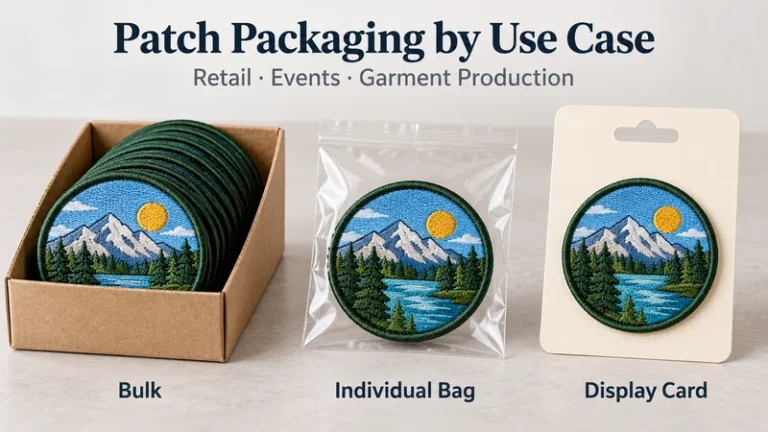
Packing and delivery: loose patches, grouped by design, or applied to finished goods; destination and target date
If you do not yet know the best attachment, state that clearly and send the base material. A factory can compare options against a real specification; it cannot confirm adhesion from the word “polyester” alone. You can review custom patch options and start a project with the artwork, material and quantity you have so far.
FAQ
Is sew-on always more durable than iron-on?
Sewing is a strong choice for permanent attachment, but workmanship, fabric strength and the patch edge matter. A properly matched and tested heat-seal system may also perform well. Compare both on the actual product and required care routine rather than assuming an absolute ranking.
Can every embroidered patch be ironed onto clothing?
No. The patch needs a compatible heat-seal backing, and the garment must tolerate the required application conditions. Ask for the exact patch specification and test it on the real fabric.
Can I use iron-on patches on waterproof nylon bags?
Do not assume so. Coatings and heat sensitivity may interfere with bonding or change the bag material. Check the bag supplier’s construction guidance and test the proposed patch and adhesive before approving bulk production.
Is hook-and-loop the same as adhesive backing?
No. Hook-and-loop is a removable mechanical fastening system with two mating surfaces. Pressure-sensitive adhesive is a separate backing type and should not be substituted in an RFQ.
Does a hook-and-loop order include the loop panel?
Only if it is specified and confirmed. State whether you need patches alone, separate loop panels or panels attached to the finished goods; include both dimensions and quantities.
Can I sew an iron-on patch for extra security?
This may be possible for some constructions, but confirm the patch edge, backing and sewing access with the maker. Do not assume a dense edge or unusual shape leaves a suitable sewing path.
What information matters most for a bulk order?
The approved sample, finished size, artwork version, patch construction, backing, base material, placement, quantity split, care requirements and packing instructions. Keep those specifications consistent between the quote, sample and production order.
Ready to compare the options for a real product? Send the artwork, base material, quantity and intended application. We can review the backing choice before you commit to a sample or bulk order.